
DC fast charging: station power and planning charging stops
DC fast charging supplies regulated direct current from equipment outside the car, bypassing its onboard AC charger. CharIN: Combined Charging System design guide V7 For a useful charging stop, match the station's capabilities to the vehicle and plan around the energy needed for the next leg of the journey.
How the station supplies DC
At a grid-fed station, power electronics convert AC from the electricity supply into controlled DC. The conversion equipment can be housed with the cable and screen or in a separate cabinet serving charging dispensers. A dispenser is the unit the driver connects to; its position does not tell you how much power equipment it shares with neighbouring spaces. OIML G 22: electric vehicle supply equipment metrology
In CCS charging, the vehicle and station establish communication, exchange capabilities and complete electrical safety checks. The station matches its output voltage to the vehicle before high-current charging begins, then adjusts delivery to the vehicle's requests within the station's limits. A failure in connection detection, authorisation or the safety checks can stop the session before energy flows. CharIN: Combined Charging System design guide V7
EV charging: how the system works explains the wider AC and DC power paths. The communication and service layers are covered in EV charging protocols and services.
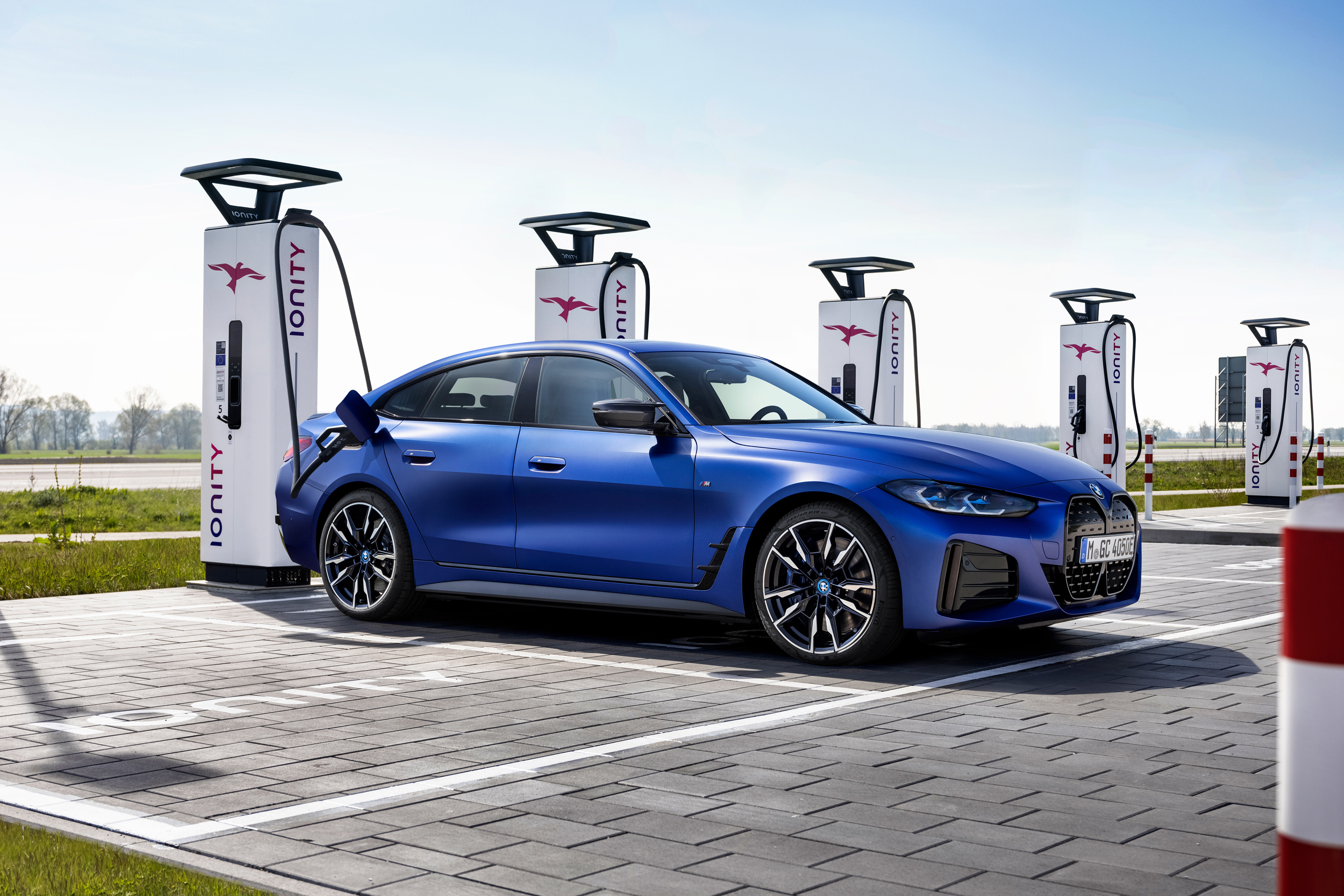
Available power and power sharing
The power advertised on a charger is a maximum for specified operating conditions. Available output also depends on voltage, current and the power allocated to that connection. CharIN's DC power-class document describes operating ranges using all three quantities. CharIN: DC CCS power classes V7.2
DC power (kW) = voltage (V) × current (A) ÷ 1,000
Consider a hypothetical output rated at 350 kW and limited to 500 A, with a voltage range that includes both 400 V and 700 V. At an actual 400 V, the current limit allows at most 200 kW. At 700 V, 500 A corresponds to the full 350 kW. At 900 V, even if that voltage is supported, the 350 kW power rating still applies: the output cannot deliver 450 kW simply because voltage multiplied by its maximum current gives that result.
These are electrical ceilings. The car may request less, and temperature-related limits can reduce the station's output. CharIN: DC CCS power classes V7.2 Operators can also impose temporary power limits: Electrify America says its maintenance team may reduce power while making improvements and updates, with affected chargers identified in its app. Electrify America: charging and troubleshooting FAQ Vehicle voltage conversion and battery acceptance are explained in EV battery charging: power, charging curves and charging time.
A separate restriction arises when several outputs share capacity. A site controller can divide the available power among charging vehicles and adjust that allocation as demand changes. US Department of Energy: smart charge management implementation In a hypothetical system with 400 kW available at its DC outputs, two vehicles might receive 200 kW each. If one requests only 100 kW, a system able to reallocate capacity could offer up to 300 kW to the other, provided its output hardware and the vehicle support it. An equal split is one allocation policy, not a property of every multi-output charger.
The shared limit can apply to a cabinet or to the whole site. Moving to an adjacent dispenser may therefore leave the same restriction in place. Smart charging and grid integration explains site-capacity management in more detail.
Plan the energy and time needed
Choose the next suitable charging stop and enough departure energy to reach it with a reserve. Allow for the expected speed, weather, elevation and load, plus an alternative site if the intended stop is unavailable. Include the detour, possible queue and connection process when assessing the stop's total time.
A published 10–80% time provides a defined state-of-charge window for comparing charging performance under the stated conditions. Read it alongside the exact battery version and energy added: cars with different battery capacities cover different amounts of energy in that window. Battery preparation and station capability also affect the result. EV battery charging: power, charging curves and charging time explains charging curves and how displayed state of charge relates to battery energy.
A station's delivered-energy reading measures energy supplied at the vehicle connection. The station's AC-to-DC conversion losses occur before that measurement boundary. OIML G 22: electric vehicle supply equipment metrology Inside the vehicle, charging losses—including losses in any onboard voltage conversion—and systems such as battery heating and cooling reduce the share stored in the cells. Charging loss explains these measurement boundaries. To estimate added driving distance, use energy available from the battery and consumption on that same basis.
As the battery fills, many vehicles reduce charging power. Electrify America advises checking the vehicle manufacturer's information because the point at which charging slows varies. Electrify America: charging and troubleshooting FAQ Use the car's charging curve and the next leg's energy requirement to choose a departure point. Charging beyond 80% can be sensible before a long gap between sites; leaving earlier can save time when sufficient energy is already available and power has fallen.
Prepare the battery using the vehicle's supported fast-charge function. In its Model 3 cold-weather guidance, Tesla recommends navigating to a Tesla charging location with Trip Planner for at least 30–45 minutes before arrival. For a shorter drive, it suggests preconditioning the battery before departure as well. Scheduled departure preparation warms the cabin and battery for driving; route-based preparation targets charging conditions. Tesla Model 3 manual: cold-weather preparation Check the instructions for the exact vehicle and software, including whether a destination selected in a phone app triggers battery preparation.
Choose a suitable charging site
Count usable charging ports, rather than cables alone. A charging port, also called a charging point, serves one vehicle at a time even when it offers multiple connectors. U.S. Alternative Fuels Data Center — Electric vehicle charging stations Electrify America's FAQ gives a concrete example: on the dual-connector chargers it describes, only one connector can be used at a time. Electrify America: charging and troubleshooting FAQ
Before relying on a site, check:
- The exact vehicle's access, connector or approved adapter, and compatible voltage range.
- Available charging ports, reported faults or reduced power, and any known power sharing.
- Opening hours, cable reach and parking layout, including space for an attached trailer.
- Payment options, the applicable tariff, parking restrictions and a reachable alternative site.
Use the operator's current map or app for availability. The map below is a historical snapshot from June 2023 and should not be used to plan a current trip.
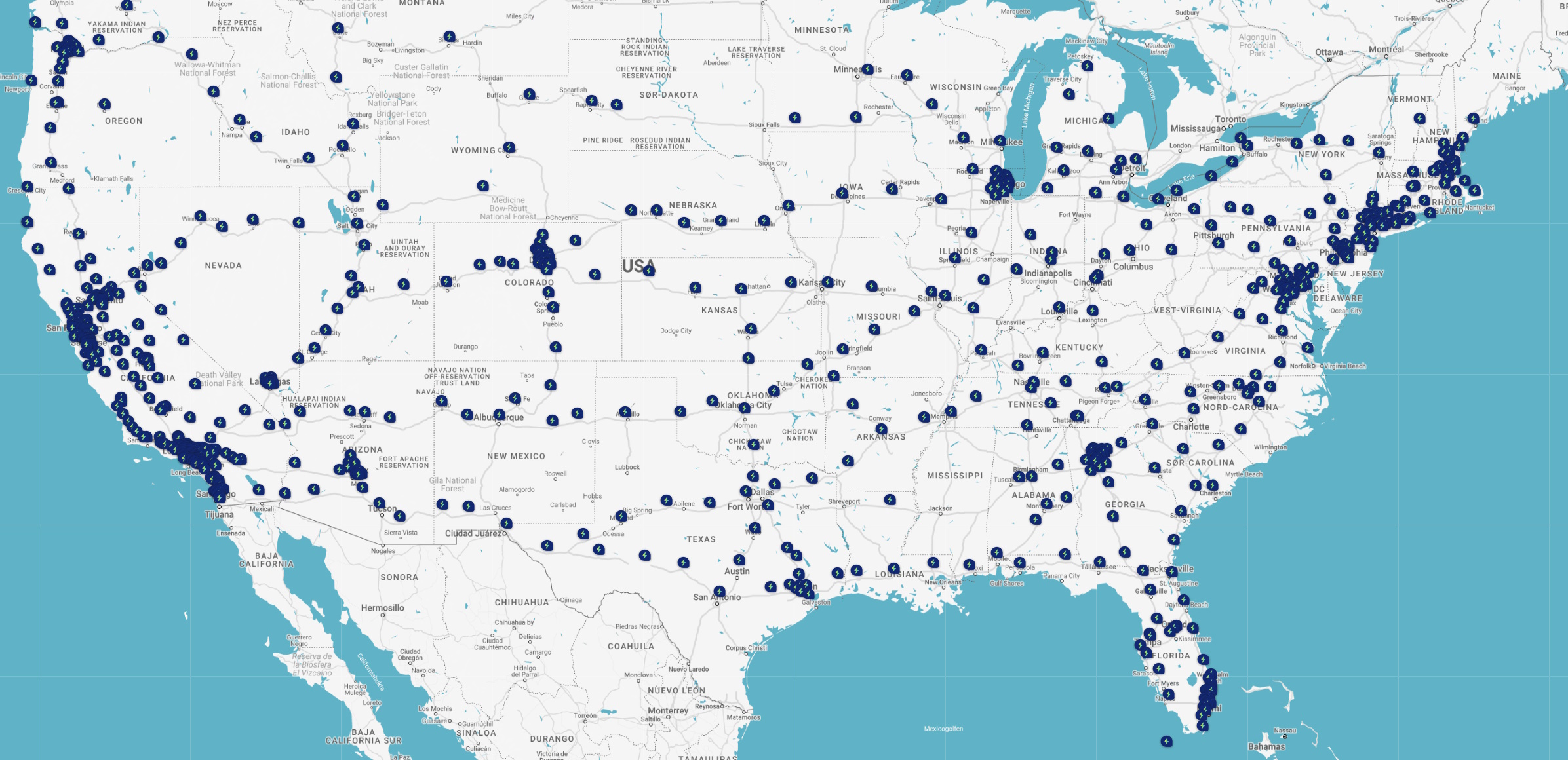
In North America, enter the exact vehicle in Tesla's app or map to find compatible Supercharger sites, then check cable reach for its charging inlet. Tesla: Supercharging other EVs in North America EV charging connectors and inlets covers regional interfaces and adapter requirements.
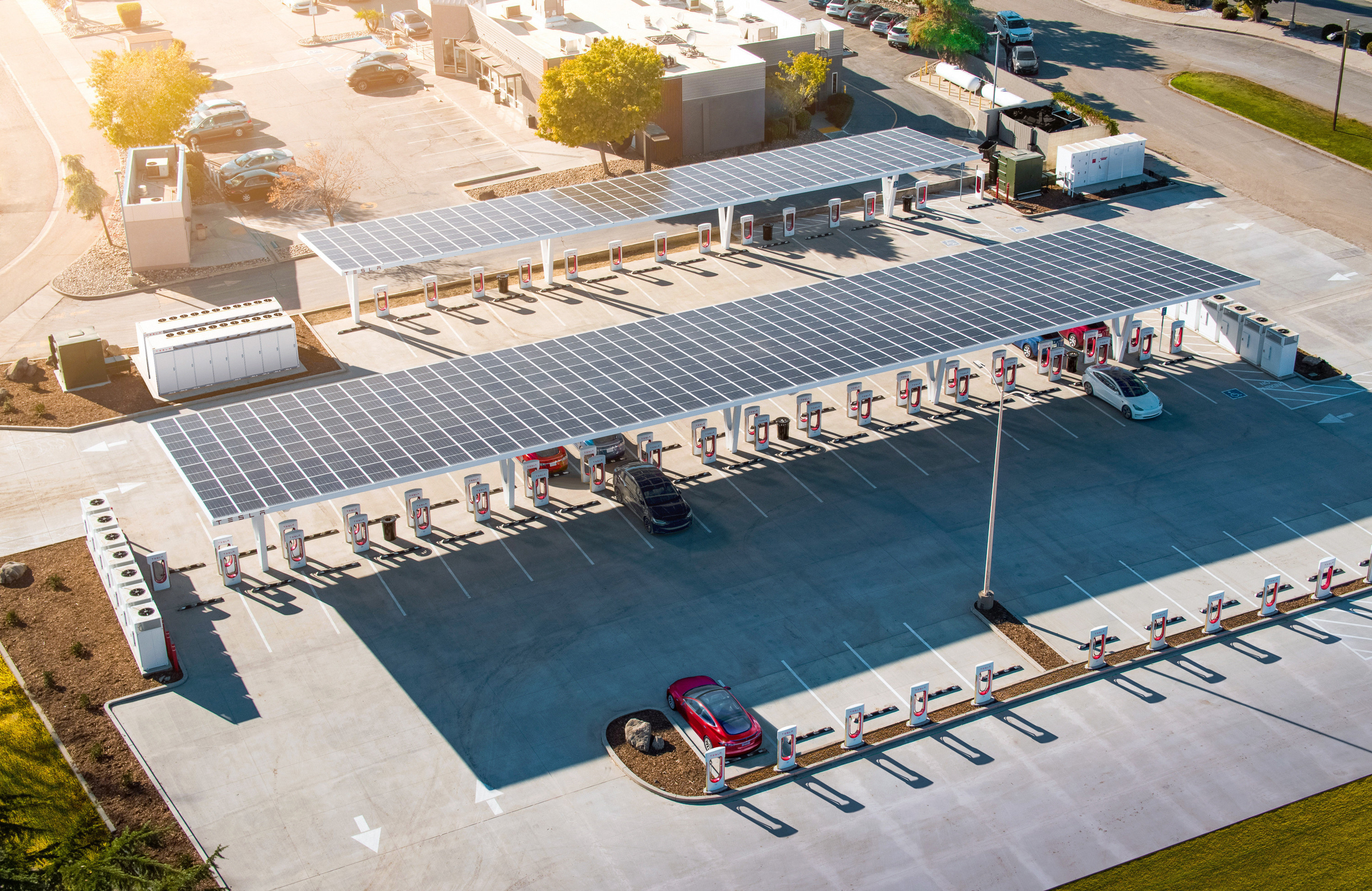
Check access to toilets, food and shelter if you plan to use the charging stop for a break.
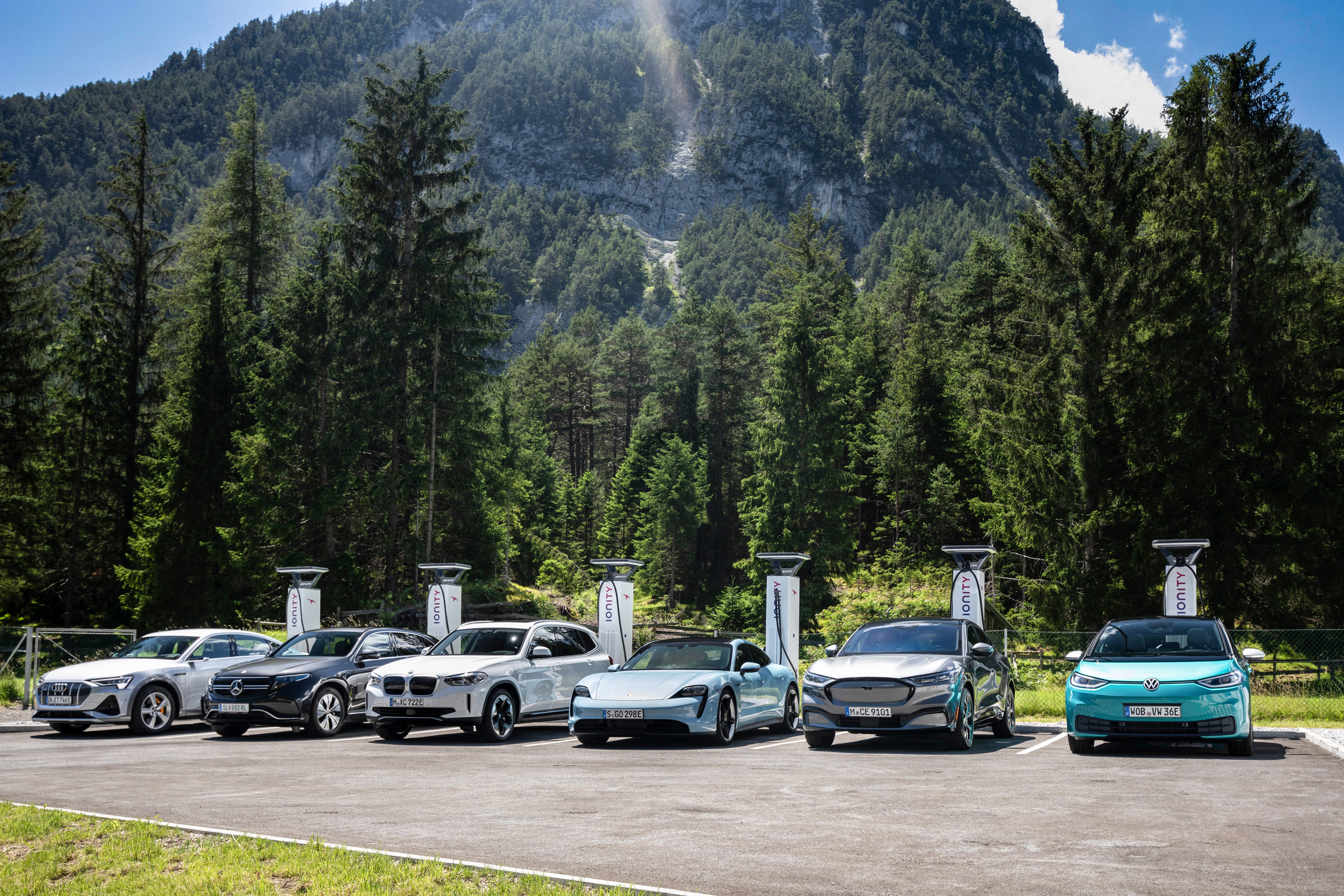
Start the session and check the price
Follow the station's displayed instructions for connecting and authorising the session. A network may offer a payment terminal, app, RFID credential or vehicle-based authorisation. With compatible Plug & Charge services, the vehicle and station can handle identification and billing automatically through the charging connection. CharIN — Plug & Charge and ISO 15118 interoperability EV charging protocols and services explains the certificates, accounts and network services behind these options.
Check the price for your chosen payment method before authorising the session. Compare the operator's direct tariff with any roaming or subscription offer, including time-based charges, subscription costs and separate parking fees. Once charging starts, confirm that power is flowing and check the intended departure target.
In the EU, AFIR requires paid, publicly accessible charging points to offer ad hoc charging without registration or an ongoing charging-service contract. European Commission: AFIR questions and answers At points rated at least 50 kW and deployed from 13 April 2024, payment must be possible through a card reader or a contactless device capable of reading payment cards. Portuguese Competition Authority — EV charging study and AFIR payment requirements
At those points, the operator's ad hoc price must be based on delivered kWh, with a possible per-minute occupancy fee. The price per kWh and any occupancy fee must be shown at the station before charging starts. European Commission: AFIR questions and answers
If charging will not start
Read the station and vehicle messages before trying again.
- Confirm the selected charger identifier and follow its connection and payment instructions.
- Check that the connector is fully seated and that the cable is not pulling it sideways.
- If instructed to retry, end the session using the normal stop control, unlock the vehicle as required, then disconnect and reconnect. Electrify America: charging and troubleshooting FAQ
- If the fault returns, try another available charger and contact the operator using the support details at the site. Electrify America: charging and troubleshooting FAQ
- Keep enough energy to reach an alternative, and record the charger identifier, time and error message for the operator.
Follow the vehicle and network's adapter requirements. For example, Tesla's North American guidance permits NACS DC adapters supplied by Tesla or the vehicle manufacturer and prohibits third-party adapters. Tesla: Supercharging other EVs in North America If a connector stays locked, follow the vehicle's release instructions; do not pull it out forcibly. Hyundai — Charging connector locking and release
Inspect the cable and plug before use. Do not use damaged equipment, cracked plugs or cables with exposed wires; report them to the operator. Follow the site's emergency instructions and contact local emergency services if anyone is in immediate danger. NZ Transport Agency — Public charging safety precautions
Sources
14
- CharIN: Combined Charging System design guide V7 — CCS power path, charging sequence and system safety checks; design guide V7, May 2019.
- CharIN: DC CCS power classes V7.2 — voltage, current, power and temperature operating ranges; V7.2, December 2021.
- US Department of Energy: smart charge management implementation — allocating charging power within available site capacity.
- OIML G 22: electric vehicle supply equipment metrology — delivered-energy measurement at the vehicle connection; 2022 guide.
- Tesla Model 3 manual: cold-weather preparation — Model 3 cold-weather guidance on route-based charging preparation and departure preparation.
- U.S. Alternative Fuels Data Center — Electric vehicle charging stations — charging locations, ports and connectors.
- Electrify America: charging and troubleshooting FAQ — dual-connector use, reduced power, charging progress and troubleshooting.
- Tesla: Supercharging other EVs in North America — North American vehicle access, adapter policy and cable reach.
- CharIN — Plug & Charge and ISO 15118 interoperability — automatic identification and billing through the charging connection.
- EU Regulation 2023/1804 — Alternative fuels infrastructure — underlying EU regulation.
- European Commission: AFIR questions and answers — ad hoc access, deployment dates, price display and contract-based services.
- Portuguese Competition Authority — EV charging study and AFIR payment requirements — AFIR payment requirements, paragraph 35; Portuguese Competition Authority, October 2024.
- Hyundai — Charging connector locking and release — connector locking and release precautions.
- NZ Transport Agency — Public charging safety precautions — inspecting cables and plugs, damaged equipment and seeking assistance.