
EV battery thermal management: cooling, heating and preconditioning
A cold battery may need heating before a fast charge; a hot one may need cooling before it can accept the same power. Battery thermal management moves heat into and out of the pack, preparing it for driving or charging while limiting energy use and temperature differences.
This chapter follows the cell construction explained in Cell Formats and the vehicle integration covered in Battery Pack & Configuration.
Why temperature targets change
Low temperature increases resistance and slows the processes that let a cell accept charge. In graphite-based lithium-ion cells, excessive charging current can deposit metallic lithium on the negative electrode instead of storing it within the graphite. US Department of Energy: Enabling Fast Charging—A Technology Gap Assessment (2017) Cell Chemistry & Components explains this lithium-plating mechanism.
These limits affect both charging and driving. Tesla's Model 3 manual describes reduced charging rates and regenerative braking when the battery is cold, and battery warming before a planned charging stop. Tesla Model 3 owner's manual: cold-weather operation and preconditioning
Warming the cells can improve charging performance, but prolonged heat exposure accelerates ageing. US Department of Energy: Enabling Fast Charging—A Technology Gap Assessment (2017) The long-term effects of temperature and state of charge are covered in Battery Degradation. Before a fast-charging stop, the vehicle may prepare a battery that was already warm enough for driving; Audi describes heating a very cold e-tron GT battery for this purpose. Audi: original RS e-tron GT navigation and preconditioning
Manufacturers describe temperatures for different purposes. Audi's 2021 documentation gives 30–35°C as the original e-tron GT battery's preferred temperature. Audi: original e-tron GT battery and thermal management (2021) Porsche's 2025 Cayenne Electric announcement instead specifies a starting condition for charging: its stated optimal fast-charging curve is achievable from a battery temperature of 15°C. Porsche: Cayenne Electric high-voltage system (2025)
Heat generation and heat storage
Resistance and electrochemical losses generate heat during charging and discharging. For the resistive contribution:
P = I²R
Here, P is heating power in watts, I is current in amperes and R is resistance in ohms. At unchanged resistance, doubling current produces four times the resistive heating power. Cell reactions also have a reversible thermal contribution that can release or absorb heat, depending on the electrode materials, state of charge and current direction. Wind and Vie: Entropy Profiles for Li-Ion Batteries (2025)
Pack temperature rises when heat generation and heat entering exceed heat leaving. Cells and pack materials store thermal energy, so switching on cooling takes time to change temperatures throughout the pack.
Inside a cell, the materials' heat capacities and thermal resistances govern how temperature changes and heat reaches the cooling surface. Li and colleagues model these properties separately for the electrode assembly, current collectors and cell enclosure. Li et al.: cylindrical-cell tab design and cooling (2021)
How heat leaves the battery
Cooling involves two linked tasks: transferring heat from inside the cells to a cooling surface, then carrying it to somewhere that can absorb or reject it. The coolant or refrigerant circuit determines the second part; cell construction and its contact with the cooling structure determine the first.
Passive heat dissipation and forced air
Passive cooling loses heat through the pack structure and surrounding air. Forced-air cooling uses a fan. Air cooling can simplify hardware, but air's low heat capacity makes heat removal and temperature uniformity more difficult than with liquid cooling. Kim and Pesaran: Battery Thermal Management Design Modeling (2007)
The second-generation Nissan LEAF e+ provides a useful passive-cooling example. Nissan's 2022 technical review classifies the LEAF system as natural heat dissipation. In its repeated motorway-driving and rapid-charging test, LEAF e+ charging performance declined from the second charge as battery temperature increased. The liquid-cooled Ariya maintained charging performance in that test. Nissan Technical Review No. 88: Ariya battery and thermal control (2022)
Indirect liquid cooling
In an indirect system, solid cooling structures separate the coolant from the cells. The thermal resistance of the intervening layers affects heat removal. Kim and Pesaran: Battery Thermal Management Design Modeling (2007)
Audi's 2021 Q4 e-tron documentation describes water-glycol coolant flowing through flat channels beneath the cell compartments. A heat-conducting paste links the battery to that cooling structure, and a high-voltage heater warms the coolant when required. Audi: Q4 e-tron battery, thermal management and charging (2021)
The liquid loop carries heat away from the pack, but must then release it. A radiator transfers coolant heat to outside air when the temperature difference permits. A chiller transfers coolant heat to the air-conditioning refrigerant, allowing compressor-driven cooling when outside air alone is insufficient. Audi describes coupling the original e-tron GT's battery circuit to its refrigerant circuit under high loads. Audi: original e-tron GT battery and thermal management (2021)
With a chiller, the heat path runs from cells to cooling structure, coolant, refrigerant and finally the outside heat exchanger. Unlike radiator-only cooling, refrigeration can cool the battery below ambient air temperature.
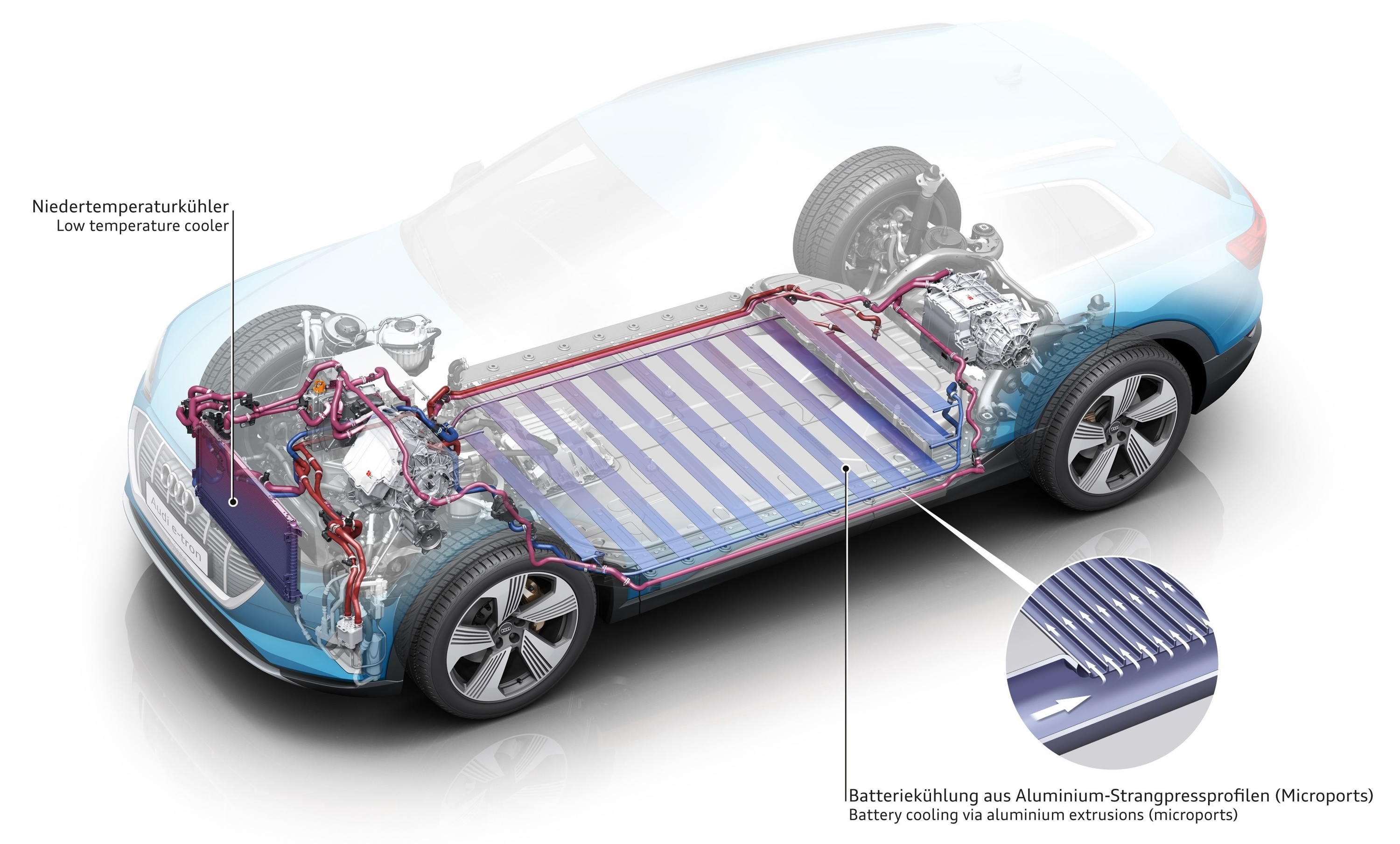
Direct refrigerant cooling
In a direct refrigerant arrangement, refrigerant passes through the battery's cooling structure without an intermediate water-glycol loop. Heat reaches it through the structure outside the sealed cells, and the refrigeration circuit carries that heat out of the vehicle. BMW described this approach in its 2013 i3 technical material. BMW i Innovation Days: refrigerant cooling (April 2013)
Cooling contact and placement
Cooling from a cell's base or side creates different heat paths through its internal materials. Li and colleagues' cylindrical-cell study shows why the enclosure and internal connections affect the result. Li et al.: cylindrical-cell tab design and cooling (2021) Cell Formats covers these directional heat paths and tab-cooling examples in more detail.
Porsche's 2025 Cayenne Electric technical announcement describes battery cooling from both above and below. This gives a concrete example of adding cooling surfaces to control temperature in a pack using large pouch cells. Porsche: Cayenne Electric high-voltage system (2025) The pack's structural role and module arrangement are covered in Battery Pack & Configuration.
How the battery is heated
A coolant heater converts electrical energy into heat and circulates that heat through the battery's cooling structure. It can prepare a cold pack without waiting for driving losses to warm it. The original Q4 e-tron system described above uses this route. Audi: Q4 e-tron battery, thermal management and charging (2021)
Heat pumps move heat between temperature levels using a refrigerant circuit. Under suitable conditions, the heat delivered exceeds the electrical energy consumed by the compressor because some of that heat comes from another source. For an air-source heat pump, colder outside air reduces the available heat and can reduce efficiency. US Department of Energy: cold-weather EV performance (2024)
Whether a heat pump can warm the battery depends on how its circuit connects to the battery loop. Heat can also flow the other way: Audi's original e-tron GT documentation describes its heat pump using high-voltage-component waste heat to warm the interior. Audi: original e-tron GT battery and thermal management (2021)
Integrated systems can redirect heat that would otherwise be rejected. Nissan describes combining cabin, battery and powertrain thermal circuits to reuse heat from driving and charging for cabin conditioning and battery temperature control. Nissan: electric vehicle thermal conditioning Recovering heat is useful when a suitable source is available; after a cold soak, there may initially be little waste heat to recover.
Temperature measurement and control
The battery management system measures voltages, current and temperatures and uses those inputs to manage the battery's operating limits. Texas Instruments: EV battery management systems Temperature sensors report conditions at their locations. They do not directly measure every point inside every cell.
Internal temperature can differ from surface temperature. NREL's extreme-fast-charging research investigated measurements inside cells and the relationship between temperature variation and uneven cell behaviour. NREL: Heat Generation Concerns Associated with Extreme Fast Charging (2020) This is why a pack-average temperature, or a single value on a dashboard, cannot fully describe its thermal condition.
Uneven coolant distribution or contact can leave warm regions in the pack. Cooling design must address local heat paths as well as total heat-removal capacity. Kim and Pesaran: Battery Thermal Management Design Modeling (2007)
The BMS and other vehicle controllers coordinate permitted power with the thermal hardware. If the battery cannot accept the requested current within its limits, the vehicle must reduce that current while heating or cooling takes effect. Battery Management System explains the monitoring and power-limit decisions; thermal management supplies the physical means to change temperature.
Predictive control adds information about what happens next. Audi's 2024 Q6 e-tron documentation describes using the departure timer, route and navigation data to plan conditioning, and also describes conditioning after use. Audi: Q6 e-tron technical facts (2024) Planning ahead matters because the cell interiors respond more slowly than a heater or compressor can be switched on.
Normal thermal management controls temperature during driving and charging; Battery Safety covers fault containment and protection against thermal-runaway propagation.
Preconditioning for charging and departure
Preconditioning brings the battery closer to the conditions needed for an upcoming task. For fast charging, this can mean warming a cold pack or cooling a hot one. Kia's 2026 US EV9 manual describes both cases and notes that preparation requires time and battery energy. Kia EV9: battery conditioning, 2026 US owner's manual
Preparing for a fast charger
Navigation-based preconditioning lets the vehicle use the planned charging stop to start preparing during the journey. For the original e-tron GT, Audi said cooling intensifies roughly half an hour before arrival at a fast charger selected in the navigation. It separately described heating a very cold battery shortly after a winter start to prepare it for fast charging. Audi: original RS e-tron GT navigation and preconditioning
Manual activation is useful when the driver chooses a stop outside the built-in route planner. Volkswagen's January 2024 ID.7 description gives Google Maps or Waze via App Connect as examples: manual preconditioning is useful when the factory route planner is inactive. Volkswagen Netherlands: automatic and manual ID.7 preconditioning (January 2024)
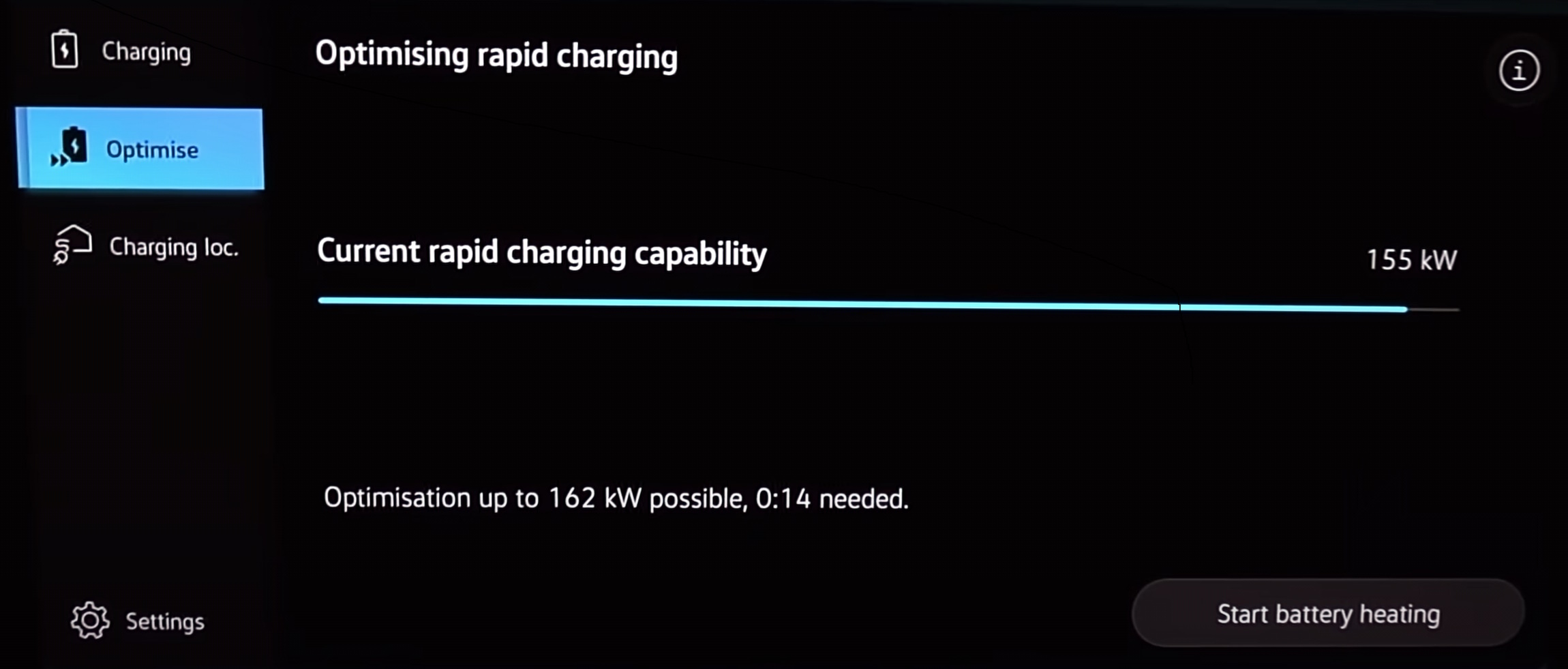
The screen above displays an estimated current rapid-charging capability of 155 kW and potential optimisation to 162 kW, with a preparation-time estimate. These are vehicle estimates, rather than charging measurements. Starting preparation only shortly before arrival may leave too little time.
An active preconditioning indicator shows that preparation is running, not that the target temperature has been reached. Once connected, charging power also depends on state of charge, the vehicle's charging curve and the charger's capabilities, as explained in Battery Charging.
Preparation before departure
Scheduled cabin conditioning, battery preconditioning and charging completion are distinct functions. A departure timer may coordinate them, but the exact behaviour needs to be checked in the vehicle's manual.
When preconditioning uses grid electricity before departure, it can preserve stored battery energy for the journey. DOE's cold-weather report illustrates this with cabin-preconditioning tests: energy consumption on a 7.5-mile (about 12 km) city driving cycle at 20°F (about −7°C) fell by 9–20%. US Department of Energy: cold-weather EV performance (2024)
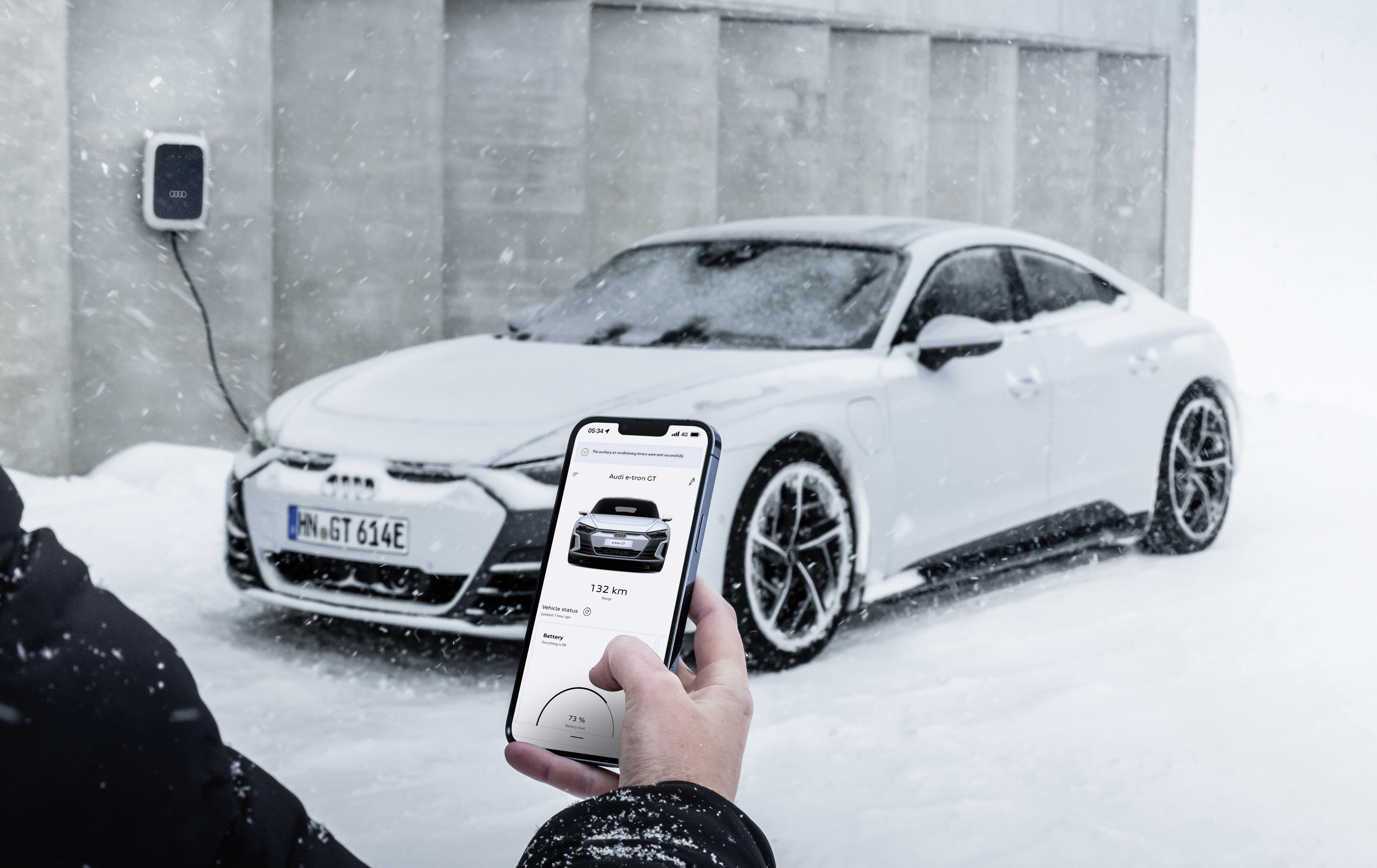
Departure preparation may warm both the cabin and battery for driving. Tesla's Model 3 manual, for example, describes battery warming as needed when cabin preconditioning is activated. Tesla Model 3 owner's manual: cold-weather operation and preconditioning Preparing for a high-power charging stop is a separate task, which may require additional battery heating or cooling.
Kia's 2026 US EV9 manual also describes app-started battery preconditioning while parked. In that mode, operation ends when the battery reaches the appropriate temperature range or after 30 minutes. Kia EV9: battery conditioning, 2026 US owner's manual
Low charge and activation limits
Preconditioning consumes energy that may also be needed to reach the charger. Kia's 2026 US EV9 manual says the function may be unavailable at low charge to preserve driving range, without specifying a percentage in that section. Kia EV9: battery conditioning, 2026 US owner's manual
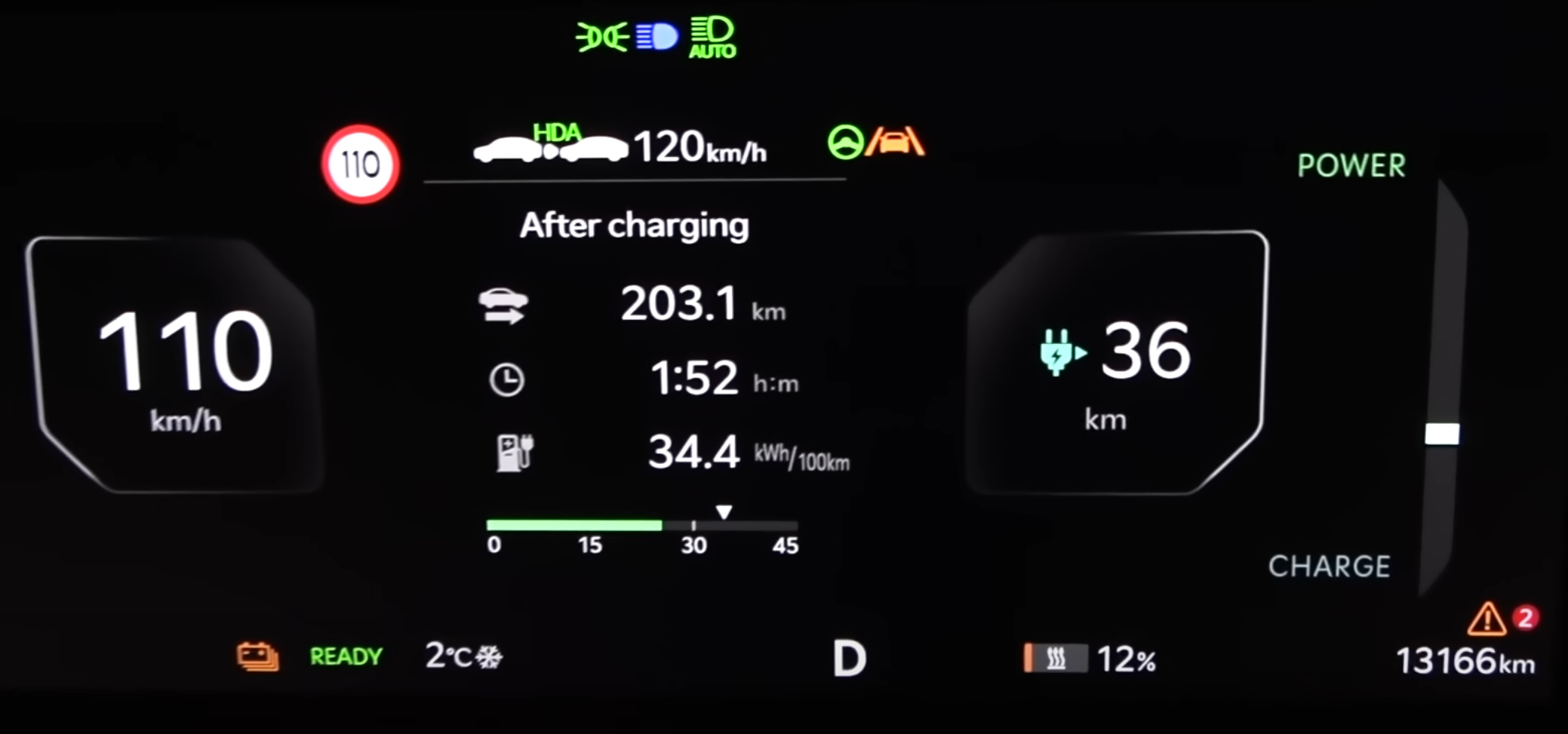
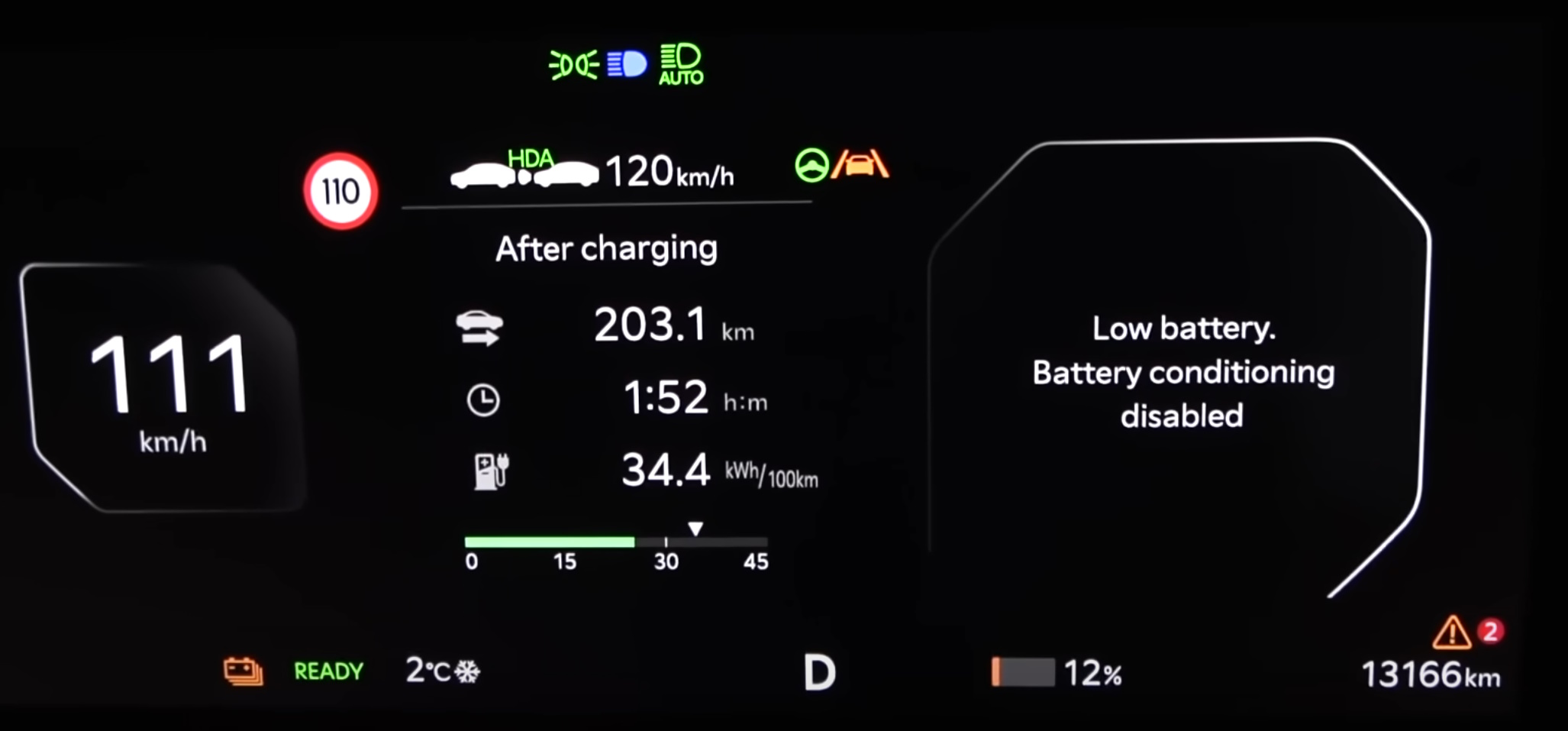
Both images show 12% SOC: one has the active preconditioning symbol, while the other displays “Low battery. Battery conditioning disabled”. The rounded SOC display records the observed states, without establishing the precise cut-off threshold.
Energy use and repeated performance
Battery preconditioning has an electrical cost. As a hypothetical calculation, a system drawing an average of 6 kW for 20 minutes consumes 2 kWh. At an assumed driving consumption of 18 kWh/100 km, that is the energy used for about 11 km of driving.
The 2 kWh describes electrical energy drawn, not heat delivered to the cells. A resistive heater converts electricity to heat, while a heat pump can add heat collected elsewhere; some heat also warms other components or escapes to the surroundings.
On a journey with a fast-charging stop, using energy to prepare the battery can reduce time spent charging. It does not automatically increase driving range. The comparison is between the preparation energy, any reduction in losses, and the charging time gained.
Repeated charging tests reveal a different capability from one peak-power figure, as the Nissan comparison above illustrates. A useful comparison should record ambient conditions, arrival state of charge, driving load and preconditioning settings alongside the charging results.
Sources
18
- US Department of Energy: Enabling Fast Charging—A Technology Gap Assessment (2017) — cold charging, lithium plating and thermal constraints; historical technology assessment.
- Wind and Vie: Entropy Profiles for Li-Ion Batteries (2025) — irreversible and reversible heat in commercial lithium-ion cells.
- Kim and Pesaran: Battery Thermal Management Design Modeling (2007) — air and liquid cooling, thermal resistance and temperature uniformity.
- Li et al.: cylindrical-cell tab design and cooling (2021) — cell heat capacity, internal heat paths and base-versus-side cooling.
- Tesla Model 3 owner's manual: cold-weather operation and preconditioning — cold-battery limits and preparation for departure and charging.
- Audi: original e-tron GT battery and thermal management (2021) — original e-tron GT temperature range, coolant circuits and cabin heat recovery.
- Nissan Technical Review No. 88: Ariya battery and thermal control (2022) — passive LEAF cooling and repeated-charging comparison, printed page 67.
- Audi: Q4 e-tron battery, thermal management and charging (2021) — Q4 e-tron coolant channels, thermal paste and high-voltage heater.
- BMW i Innovation Days: refrigerant cooling (April 2013) — direct refrigerant cooling described in 2013, printed page 19.
- Porsche: Cayenne Electric high-voltage system (2025) — double-sided cooling and the stated starting temperature for optimal fast charging.
- US Department of Energy: cold-weather EV performance (2024) — heat pumps and plugged-in preconditioning.
- Nissan: electric vehicle thermal conditioning — integrated circuits and reuse of driving and charging heat.
- Texas Instruments: EV battery management systems — cell and pack monitoring.
- NREL: Heat Generation Concerns Associated with Extreme Fast Charging (2020) — internal temperature measurement and temperature variation during fast charging.
- Audi: Q6 e-tron technical facts (2024) — predictive and post-use conditioning in the 2024 technical description.
- Kia EV9: battery conditioning, 2026 US owner's manual — conditioning indications, preparation time and low-charge restrictions.
- Audi: original RS e-tron GT navigation and preconditioning — route-based heating and cooling of the original e-tron GT.
- Volkswagen Netherlands: automatic and manual ID.7 preconditioning (January 2024) — automatic and manual conditioning in the January 2024 ID.7 description.