
EV battery basics: how cells store and release energy
An EV battery stores energy chemically. Charging puts its cells into a higher-energy chemical state. During driving, the cells release that energy as electricity, which the vehicle’s power electronics and motors convert into motion.
From cell to battery pack
A cell is the smallest complete electrochemical unit in the battery. A single lithium-ion cell produces only a few volts, so an EV connects many cells to obtain the voltage and energy it needs.
Cells can be assembled into modules and then into a pack, or integrated directly into the pack without conventional modules. The pack combines these cells with the equipment needed to connect, protect, and manage them. The Battery Pack and Configuration chapter covers electrical connections and pack construction; Cell Formats explains cylindrical, prismatic, and pouch cells.
What is inside a cell?
In a conventional lithium-ion cell, two electrodes hold lithium within their active materials. The negative electrode is commonly graphite-based; the positive electrode uses a lithium-containing compound. Their combination helps determine the cell’s voltage and how much energy it can store.
Battery literature usually calls the negative electrode the anode and the positive electrode the cathode. These names describe their roles during discharge and are normally retained when discussing charging.
Three other components connect and separate the electrodes:
- The electrolyte carries ions between them. Conventional liquid electrolytes contain a lithium salt dissolved in organic solvents.
- The separator is a porous membrane that keeps the electrodes apart while allowing ions to pass through the electrolyte in its pores.
- Current collectors are conductive foils that connect the active materials to the cell terminals. Copper is commonly used on the negative side and aluminium on the positive side. Lithium-ion Batteries Technology Strategy Assessment (DOE, 2023)
The separate Cell Chemistry and Components chapter compares electrode materials and electrolyte designs.
How charging and discharging work
During discharge, lithium ions move from the negative electrode to the positive electrode through the electrolyte. Electrons flow from the negative to the positive electrode through the external circuit, supplying electrical energy to the vehicle. The electrolyte conducts ions but blocks electron flow, so the electrons take the external path.
Charging reverses the process. A power source supplies electrons to the negative electrode and removes them from the positive electrode. Lithium ions move back through the electrolyte to the negative electrode, increasing the cell’s stored chemical energy. DOE Explains: Batteries
Regenerative braking charges the battery using energy recovered from the vehicle’s motion: the motor acts as a generator and returns electrical energy through the power electronics.
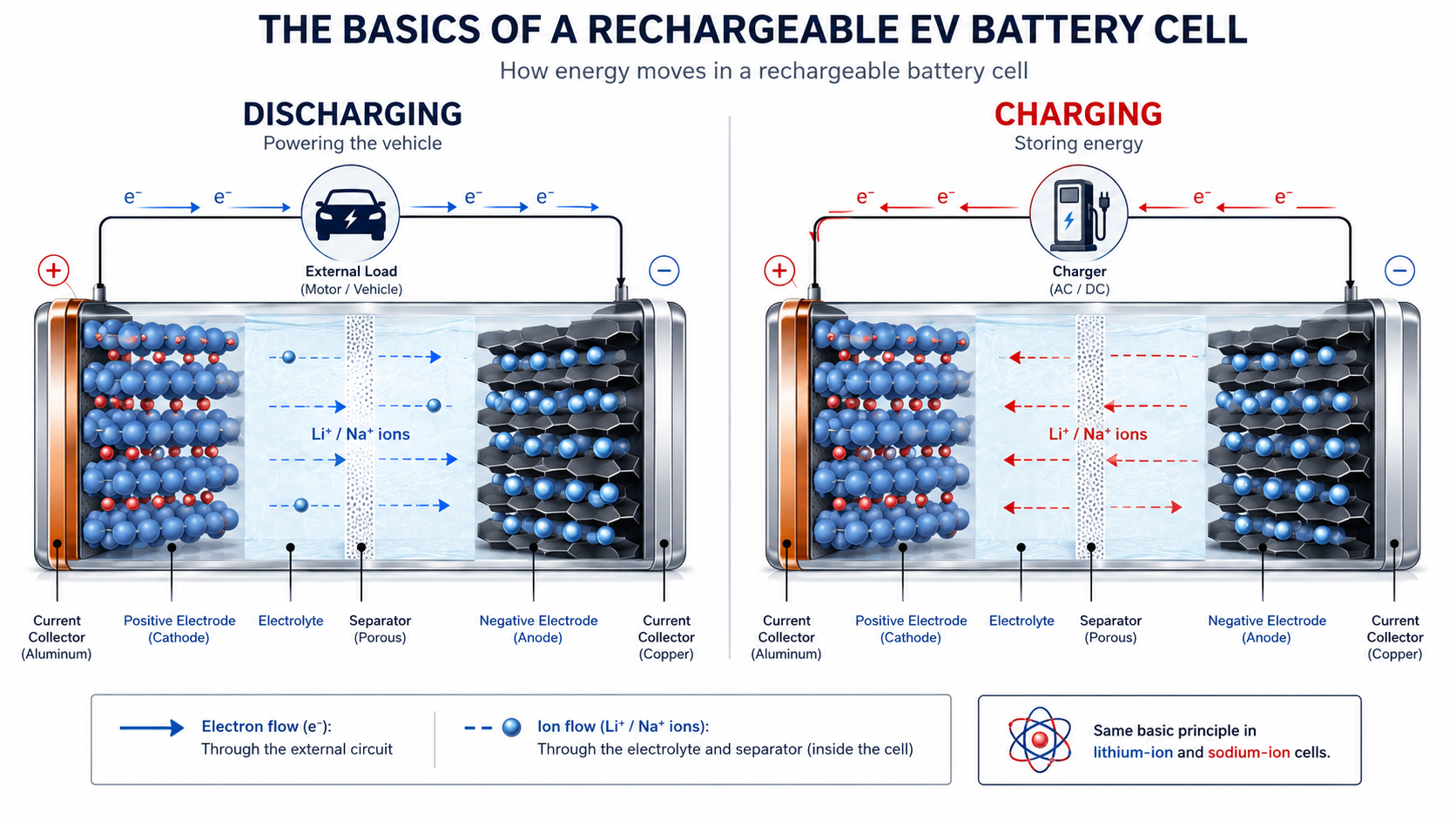
Lithium-ion and sodium-ion cells share this operating principle. The illustration shows lithium ions (Li⁺) and sodium ions (Na⁺) moving between electrodes. Sodium-ion cells use materials suited to sodium’s different properties. first-generation sodium-ion battery announcement (CATL, 2021)
Voltage, current, power, and energy
Battery specifications use several quantities that answer different questions:
- Voltage, measured in volts (V), is the electrical potential difference between two points.
- Current, measured in amperes (A), is the rate at which electric charge flows.
- Charge capacity, measured in ampere-hours (Ah), is the amount of charge a cell or battery can deliver under specified conditions.
- Power, measured in kilowatts (kW), is the rate at which energy is delivered or received.
- Energy, measured in kilowatt-hours (kWh), is the amount delivered, received, or stored.
At the battery’s direct-current terminals:
Power (kW) = Voltage (V) × Current (A) ÷ 1,000
For example, a battery supplying a steady 20 kW for half an hour delivers:
20 kW × 0.5 h = 10 kWh
That is energy delivered at the battery terminals. Energy reaching the wheels is lower because the power electronics and motor also have losses. Likewise, energy drawn from a charger exceeds the increase in stored battery energy because charging has losses.
An approximate nominal energy value can be calculated from charge capacity:
Energy (kWh) ≈ Nominal voltage (V) × Capacity (Ah) ÷ 1,000
Ah alone is therefore insufficient to compare the energy in batteries with different voltages. The approximation uses a representative voltage; a precise energy measurement accounts for voltage as it changes during charging or discharging.
State of charge and operating limits
State of charge (SOC) expresses the estimated remaining charge as a percentage of a defined capacity. SOC is estimated from measurements such as current, voltage, and temperature. State of Charge Estimation Using Smart Battery Charger (Texas Instruments, 2021)
An EV’s displayed percentage is mapped to its driver-accessible operating window. Displayed 0% and 100% are not the cell’s absolute electrochemical limits. The Battery Buffer and Usable Capacity chapter explains gross and net (usable) capacity and buffers.
Cell voltage varies with SOC, chemistry, temperature, and current. Nominal voltage is a reference value, not a charging limit. For example, Molicel specifies 3.6 V nominal voltage, 4.2 V charging voltage, and a 2.5 V discharge cut-off for its INR-21700-P42A cell. Other cell designs can use different voltage limits. Molicel INR-21700-P42A datasheet, version 1.7
The upper and lower voltage limits affect charging and driving differently. Near full charge, charging power tapers to keep cells within their upper voltage limits. At low charge, the vehicle may reduce propulsion power to keep cell voltages above their lower limits. The Battery Charging chapter explains how charging limits shape the power delivered through a session.
The battery management system (BMS) monitors cell or parallel-group voltages, battery current, and temperatures at sensor locations. It estimates battery state and coordinates permitted charging and discharging with the vehicle to keep the cells within their operating limits. Battery Management System techbook The Battery Management System chapter covers these functions in more detail.
Why temperature and current matter
Internal resistance produces heat when current flows. At the same resistance, doubling the current produces four times as much resistive heating. Cold conditions can increase resistance and reduce available power. Cell reactions can also absorb or release heat. This reversible effect depends on chemistry and state of charge. Entropy Profiles for Li-Ion Batteries—Effects of Chemistries and Degradation (Wind and Vie, 2025)
Temperature limits can restrict both charging and propulsion. Cold conditions are particularly challenging for charging graphite-based lithium-ion cells because lithium can deposit on the electrode surface (lithium plating) instead of entering its structure. The vehicle’s controls reduce charging current and may warm the battery first.
Regenerative braking can be limited by a cold or full battery because both conditions restrict the power the battery can accept. Model 3 owner’s manual: Braking and Stopping Heating and cooling systems help maintain suitable conditions, as explained in Battery Thermal Management.
The video below from The Limiting Factor illustrates lithium-ion cell operation.
Sources
8
- DOE Explains: Batteries
- Lithium-ion Batteries Technology Strategy Assessment (DOE, 2023)
- first-generation sodium-ion battery announcement (CATL, 2021)
- Molicel INR-21700-P42A datasheet, version 1.7
- State of Charge Estimation Using Smart Battery Charger (Texas Instruments, 2021)
- Battery Management System techbook
- Entropy Profiles for Li-Ion Batteries—Effects of Chemistries and Degradation (Wind and Vie, 2025)
- Model 3 owner’s manual: Braking and Stopping