
EV Reduction Gears and Transmissions
Most EVs advertised with a “single-speed transmission” still contain gears. A fixed reduction converts the motor’s high rotational speed into lower wheel speed and higher wheel torque; only a true direct-drive or in-wheel layout can dispense with that reduction stage.
Why an EV needs reduction gearing
Traction motors can operate at many thousands of revolutions per minute, while a road wheel turns far more slowly. A reduction ratio allows a compact high-speed motor to work in a useful part of its speed and efficiency map.
Ignoring tyre deformation, differential action, and losses:
wheel torque ≈ motor torque × reduction ratio × driveline efficiency
A 9:1 reduction therefore multiplies shaft torque by somewhat less than nine after mechanical loss. It also means the motor turns about nine times for one wheel revolution. Gear reduction does not create power; it trades speed for torque.
Fixed single-speed reductions
The standard passenger-EV solution is one fixed ratio for each driven axle. The gear train may use one or two reduction stages with helical or spur gears, a planetary stage, or a mixture. The motor can sit coaxially with the axle or parallel to it, changing shaft count, bearing loads, package shape, and gear geometry.
A fixed ratio avoids shift actuators and torque interruptions. Electric motors can start from zero speed, reverse electrically, and operate across a wide constant-torque and constant-power range, so most EVs do not need the many ratios used to keep a combustion engine near a narrow efficient speed band.
“Single speed” describes the number of selectable ratios, not the number of gear meshes. A two-stage fixed reducer can still be a single-speed transmission.
Choosing the ratio
A shorter total reduction ratio—numerically larger—raises wheel torque for launch and climbing, but makes the motor turn faster at every road speed. Maximum motor speed may then limit vehicle top speed, while high electrical frequency can increase iron, inverter, windage, and bearing losses.
A taller ratio reduces motor speed at a given road speed and can extend top speed, but requires more motor torque and current for the same wheel force. That can increase copper and inverter loss and may demand a larger motor.
Engineers select the ratio together with tyre rolling radius, vehicle mass, gradeability, towing target, top speed, motor torque-speed curve, efficiency map, voltage, inverter current, cooling, and noise. Changing wheel or tyre diameter also changes the effective road ratio.
The differential
A conventional open differential lets left and right wheels rotate at different speeds in a corner while transmitting essentially equal torque through its side gears. It does not guarantee equal power, and when one wheel has very little grip, equal axle-shaft torque can limit the useful drive force.
A limited-slip or electronically controlled differential can bias torque mechanically. Brake-based traction control can slow a spinning wheel. An axle with two independent motors can control left and right torque electrically, but still needs reduction gears and may use separate final-drive paths.
Multi-speed EV transmissions
A second selectable ratio can combine a short launch gear with a taller high-speed gear. The potential benefits are higher wheel torque without an oversized motor, a broader top-speed range, and the ability to move operating points into a more efficient part of the motor map.
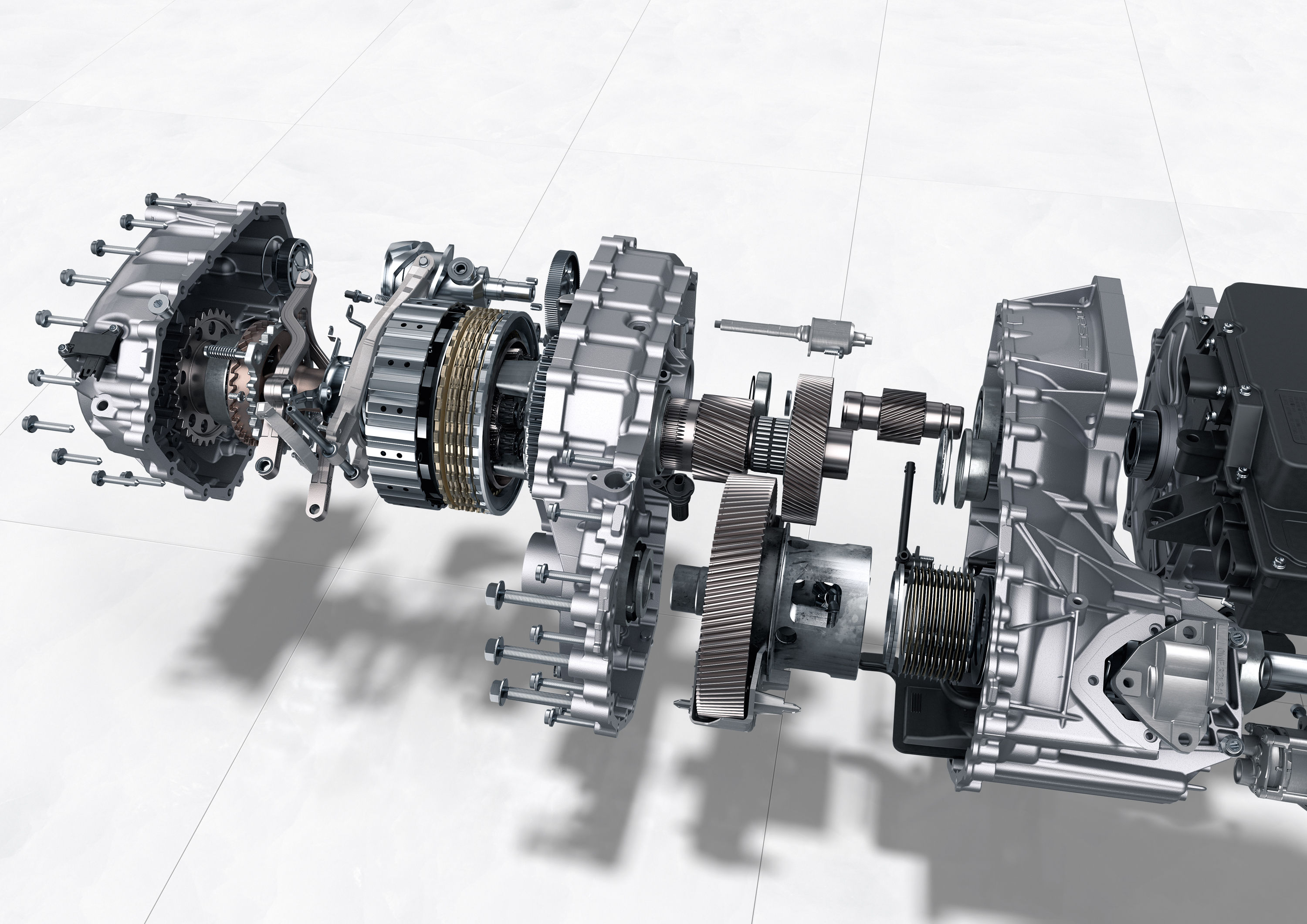
The Porsche Taycan is a production example. Its rear axle uses a short first gear for launch performance and a longer second gear for high-speed efficiency and power reserve, while its front axle uses a fixed one-speed reduction.
The second ratio also adds gears, bearings, clutches or dog elements, an actuator, controls, lubrication demand, mass, cost, shift calibration, and possible torque interruption. A wider-speed motor with one fixed ratio may deliver better vehicle-level cost and efficiency. That is why multi-speed passenger EVs remain the exception rather than the default.
Disconnects and multi-motor drive units
An all-wheel-drive EV may carry an inactive secondary motor during cruising. A disconnect clutch can separate that motor and part of its gear train from the wheels, reducing electromagnetic, bearing, seal, and oil-churning losses. The penalty is actuator complexity, engagement time, mass, and another durability-critical mechanism.
An induction motor can often be de-energized with low electromagnetic drag, reducing the need for a mechanical disconnect. A permanent-magnet motor continues to create rotor flux, but careful inverter control and low-loss gear design can still make zero-torque operation practical.
Efficiency, lubrication, and noise
Gear losses come from tooth sliding and rolling, bearings, seals, oil churning, pumps, and differential motion. Efficiency varies with speed, torque, oil temperature, oil level, tooth finish, bearing preload, and lubrication method. A quoted best-point gearbox efficiency is not the loss across an entire drive cycle.
High motor speed pushes gear-mesh frequencies into acoustically sensitive ranges. Tooth microgeometry, ratio selection, shaft and housing stiffness, bearing support, rotor balance, and inverter harmonics all affect the whine heard in the cabin. A quieter gear may require a compromise in contact stress, manufacturing cost, or efficiency.
Oil must protect teeth and bearings while avoiding excessive churning. Some integrated drive units use an electric pump and dry-sump strategy to deliver oil where needed without leaving rotating gears deeply immersed.
Reading torque claims
Motor torque is measured before reduction; axle or wheel torque is measured after it. Multiplying motor torque by a large gear ratio produces a large wheel-torque number, but power and acceleration remain bounded by motor speed, battery power, inverter limits, tyre grip, vehicle mass, and loss.
Check the measurement point, whether a figure is peak or continuous, whether it covers one axle or the complete vehicle, and whether the ratio changes between gears. Without those details, torque figures from different EVs are not directly comparable.
Return to Electric Motors and Drive Units.