
EV battery swapping: how it works and what limits access
Battery swapping exchanges an EV's traction battery for a charged one, allowing the car to leave while the removed pack is recharged at the station. Using the service requires a compatible vehicle, a suitable station and a charged pack that matches the vehicle and the customer's service entitlement.
How an automated swap works
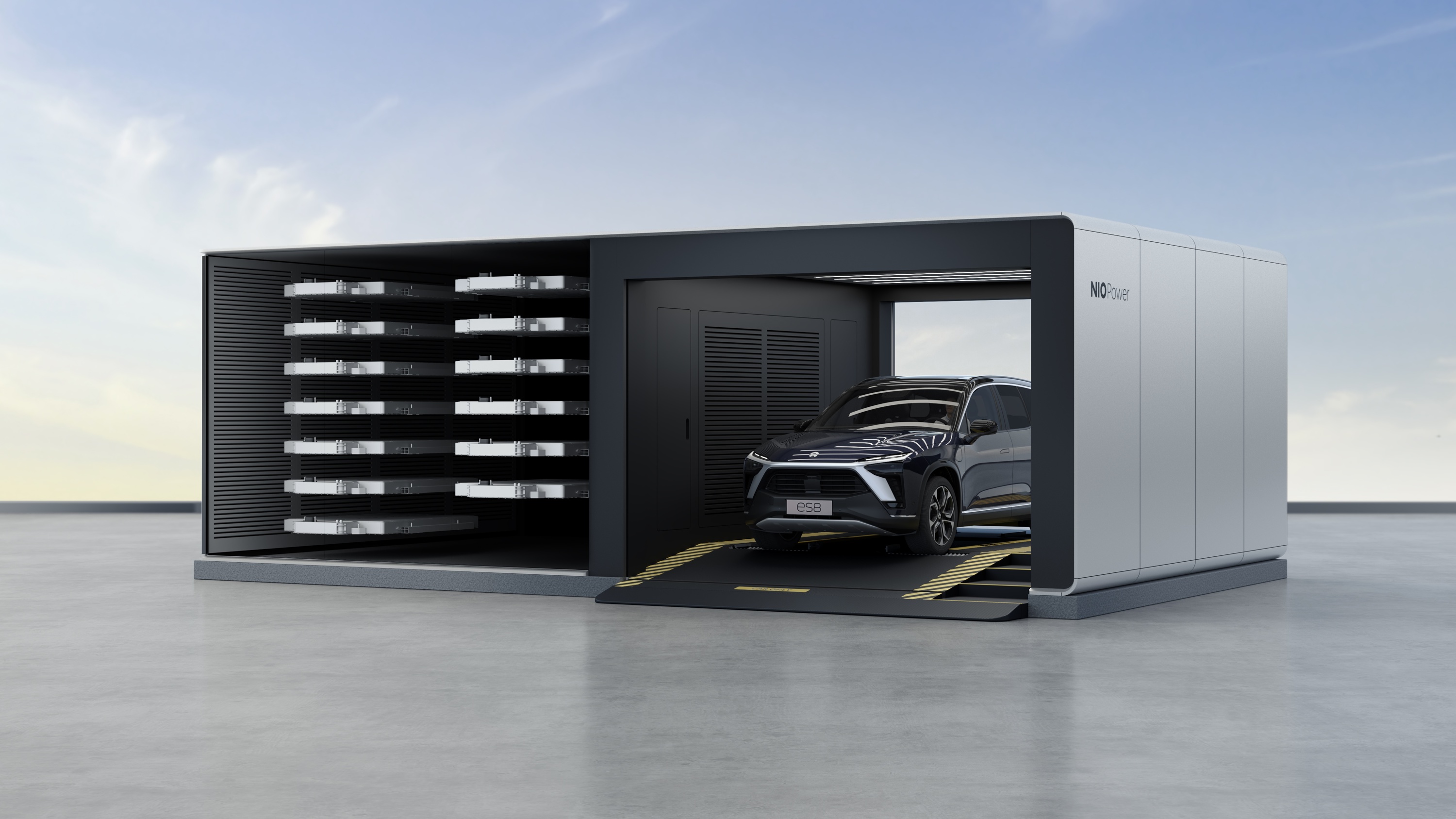
In a typical underbody swap, the vehicle is positioned above the exchange equipment and enters a dedicated swap mode. The system disconnects the battery from the vehicle's high-voltage circuit, releases its mountings and removes it. A compatible charged pack is installed, connected and checked before the vehicle can leave. Opening the high-voltage contactors isolates the pack from the vehicle; energy remains stored in its cells.
The removed battery stays at the station for charging and any required checks or temperature conditioning. Keeping several packs in circulation separates the driver's stop from the time needed to recharge each battery.
The driver's role varies by system. NIO's ET7 manual, for example, describes joining a queue, guided or assisted positioning, starting the exchange from the display and leaving after completion. Drivers should follow the instructions for their vehicle and station rather than treating every automated swap as the same procedure. NIO ET7 user manual — Power Swap with Assisted Parking
Compatibility starts with the vehicle
A swap-enabled vehicle needs mountings and connections designed for repeated exchange. The pack must fit the vehicle, lock securely into place and work with its electrical system, cooling arrangement and control software. Compatibility therefore includes the vehicle model, pack type and station generation.
Swapping uses removable battery packs or blocks. How the cells are packaged inside them is a separate design choice: CATL's EVOGO blocks, announced in January 2022, used cell-to-pack (CTP) construction. CATL — EVOGO modular battery-swapping system Whether a pack also carries vehicle-body loads is another question. EV battery packs: configuration, construction and repairability explains internal construction, structural integration and repair access.
Common pack dimensions can help manufacturers share a swapping network, provided their vehicles are designed for its packs and interfaces. CATL — Standardized #20 and #25 Choco-Swap batteries
Software standards address another layer. OCPP 2.1 supports communication between battery-swap stations and management systems; it does not define a common physical battery interface for cars. Open Charge Alliance — OCPP 2.1 battery-swapping support
Swap time, waiting time and charged inventory
An advertised exchange time describes a particular station's operation. A driver's total stop also includes any queue, positioning and departure. NIO's ET7 manual makes this distinction visible: its order interface shows the queue, estimated wait and battery charging status before the exchange begins. NIO ET7 user manual — Power Swap with Assisted Parking
Stored packs are not all ready for the next car: some are charging or being checked, and others may be a different pack type or capacity tier. Spare packs can cover a short burst of arrivals with energy charged earlier. If arrivals exhaust that supply, drivers must wait for compatible packs to become ready.
Over a sustained busy period, the station must replenish the energy used between visits. Its grid connection, charging equipment and battery temperature limits constrain that rate. More spare packs increase the energy available for demand peaks, while adding cost and storage space.
For a journey comparison, assess the whole stop with enough departure energy for the same onward journey. If comparing energy replenishment, use the increase in usable battery energy: for a swap, subtract the usable energy left in the returned pack from that in the pack received. DC fast charging explains charging windows, energy added and total stop time.
Battery ownership and service terms
Swapping describes the physical exchange. Battery-as-a-service (BaaS) describes a commercial arrangement in which the customer pays for battery access separately from the vehicle. NIO's Norwegian BaaS offer, for example, lets customers buy a car without buying the battery and subscribe to a capacity tier with access to Power Swap. NIO Norway — Battery as a Service
In December 2024, NIO began offering BaaS customers in Germany, the Netherlands, Norway and Sweden a 100 kWh pack in place of the standard 75 kWh pack, one month at a time and subject to availability. This lets customers obtain extra capacity for a trip without buying the larger battery. NIO — Flexible battery upgrades in four European markets
A lower vehicle purchase price leaves ongoing battery costs to compare. Before choosing a service, check:
- The battery subscription, energy charge and swap fee, including any allowances or limits.
- The promised capacity tier, replacement-pack condition and state of charge at handover.
- Eligibility, booking rules and charges for temporary capacity upgrades.
- Responsibility for damage or faults, and the rules for ending the subscription, resale or export.
The customer receives another pack from the service's inventory. NIO's Norwegian BaaS page says users are guaranteed a healthy and safe battery and do not bear the cost of battery degradation. NIO Norway — Battery as a Service Check the service agreement for how battery condition is defined and assessed. Assessment, repair and later reuse are covered in EV battery lifecycle: repair, second life and recycling.
Safety during repeated exchanges
Swapping repeatedly separates and reconnects a heavy, high-voltage assembly. Secure mechanical locking and correct electrical connection are central design requirements. Pack identification and fault handling must also prevent an incompatible or faulted battery from being returned to service.
The August 2026 firefly announcement says NIO's fifth-generation stations check battery health during each exchange. Inspection scope and the response to a detected fault are specific to the operator's system. firefly — Fifth-generation NIO swap stations begin operating in China
China's recommended national standard GB/T 40032-2021 sets safety requirements, test methods and inspection rules for battery-swappable M1 battery-electric passenger cars. Its scope includes swapping systems, mechanisms and interfaces during exchanges and vehicle operation. SAMR — Scope of GB/T 40032 battery-swapping safety requirements It took effect in November 2021 and is listed as current by the national standards authority. GB/T 40032-2021 — Safety requirements for EV battery swapping
The broader mechanisms of electrical isolation, thermal runaway and pack protection are explained in EV battery safety: thermal runaway, protection and incident response.
Operating examples and suitable uses
NIO's fourth-generation stations began operating in China in June 2024. NIO specified storage for 23 batteries, a 144-second swap and capacity for up to 480 swaps per day. The daily maximum is a design figure for that generation, not measured throughput at a particular site. NIO — Power Swap Station 4.0 In August 2026, its fifth-generation stations began operating in China, adding firefly to the supported NIO and ONVO brands; the initial rollout covered seven Chinese cities. firefly — Fifth-generation NIO swap stations begin operating in China Support differs by station generation, so check which local stations accept the exact model.
CATL's January 2022 EVOGO launch described compatible cars carrying one to three exchangeable blocks. CATL — EVOGO modular battery-swapping system In December 2024, CATL introduced two standardised Choco-Swap packs, #20 and #25, each with LFP and NMC chemistry options. CATL — Standardized #20 and #25 Choco-Swap batteries CATL reported more than 1,470 Choco-Swap stations across 99 Chinese cities in April 2026. CATL — April 2026 Choco-Swap network update
For taxis and other frequently used vehicles, shorter stops can leave more time for paid work. Concentrated demand from compatible vehicles can spread the cost of the station and spare packs over more exchanges. Whether swapping costs less than charging depends on utilisation, service charges and the charging stop it replaces.
Plug-in charging remains available alongside swapping in these systems: CATL designed EVOGO to support both, and NIO describes swaps as complementing home and fast charging. CATL — EVOGO modular battery-swapping system NIO — Flexible battery upgrades in four European markets A driver who can recharge during an existing overnight or workplace stop may gain little time from a separate swap visit. On a long journey, the benefit depends on stations along the route having a charged, compatible pack. See EV charging: how the system works for how these options fit together.
Sources
11
- NIO ET7 user manual — Power Swap with Assisted Parking — queue information and the driver's swap procedure.
- NIO — Power Swap Station 4.0 — June 2024 fourth-generation station specifications.
- firefly — Fifth-generation NIO swap stations begin operating in China — August 2026 launch, compatibility and battery health checks in China.
- CATL — EVOGO modular battery-swapping system — January 2022 modular system, CTP construction and charging compatibility.
- CATL — Standardized #20 and #25 Choco-Swap batteries — December 2024 standardised battery announcement.
- CATL — April 2026 Choco-Swap network update — reported Chinese network coverage in April 2026.
- NIO Norway — Battery as a Service — Norwegian battery subscription model.
- NIO — Flexible battery upgrades in four European markets — December 2024 monthly upgrade rollout in four European markets.
- GB/T 40032-2021 — Safety requirements for EV battery swapping — official standard identity, implementation date and current status.
- SAMR — Scope of GB/T 40032 battery-swapping safety requirements — SAMR's description of the standard's vehicle scope and safety requirements.
- Open Charge Alliance — OCPP 2.1 battery-swapping support — scope of OCPP 2.1 battery-swapping support.