
EV suspension: wheel control, ride comfort and handling
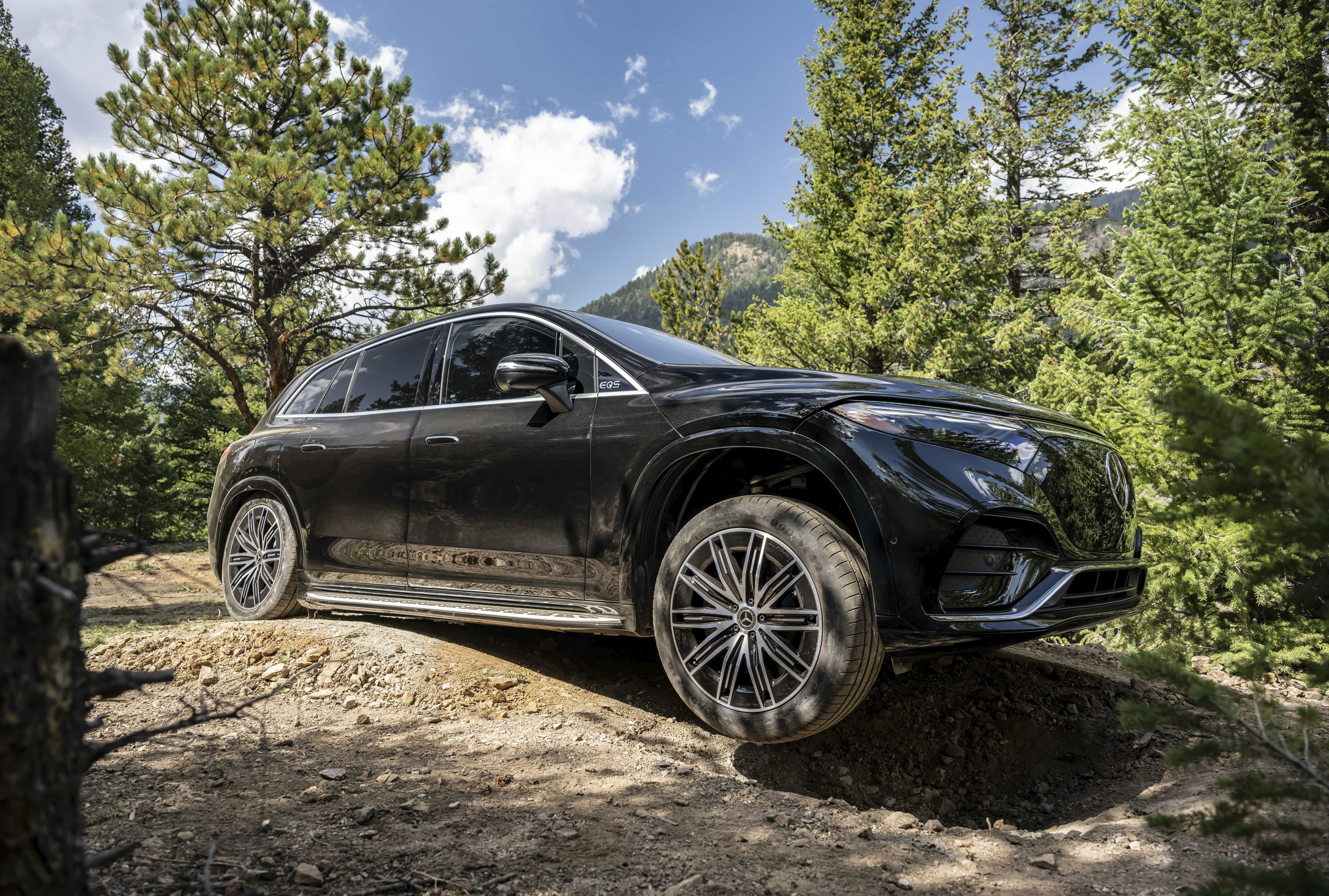
The suspension is the mechanical and electronic system that manages the forces between an EV's tyres and its body. Its job is not simply to make the ride soft: it must preserve usable tyre load, control body motion, provide suspension travel, isolate noise and vibration, and carry the vehicle safely through braking, acceleration and cornering.
What the suspension controls
A road input begins at the tyre contact patch. The tyre deflects, the wheel and hub move, the suspension links guide that motion, the spring stores energy, and the damper converts part of the motion into heat. Bushings, subframes, seats and the body structure determine how much of the remaining disturbance reaches the occupants.
The system therefore has several simultaneous tasks:
- keep the wheel within a useful range of camber and toe as it moves and steers;
- limit variations in vertical tyre load so the tyre can generate predictable braking, cornering and drive force;
- control body heave (vertical motion), pitch (fore-and-aft rotation) and roll (side-to-side rotation);
- absorb road inputs without repeatedly reaching the compression or rebound stops;
- carry changing passenger, cargo and towing loads at an acceptable ride height;
- isolate structure-borne noise without making wheel location imprecise.
No suspension can hold tyre force perfectly constant. A bump, dip or steering input always redistributes load, and a tyre that is airborne cannot create road force. The engineering objective is to control the size, speed and duration of those changes within the available grip and suspension travel.
A useful model: body, wheel and road
The simplest useful suspension model represents one corner of a car with two moving masses:
- the sprung mass: the share of the body, battery, occupants and cargo supported by the spring;
- the unsprung mass: principally the wheel, tyre, hub, brake and a share of the suspension links;
- the suspension spring and damper between those masses;
- the tyre stiffness and damping between the unsprung mass and the road.
This two-degree-of-freedom “quarter-car” model is deliberately incomplete, but it exposes the central compromise. Soft isolation of the body, tight control of suspension travel and small variations in tyre load cannot all be optimized independently with a passive spring and damper. Changing one parameter moves more than one outcome. SAE: dynamic behavior of passive and active suspension systems
For a lightly damped single-mass approximation, the body's natural frequency is:
fₙ ≈ (1 / 2π) × √(kᵥ / mₛ)
Here kᵥ is the vertical wheel rate in N/m and mₛ is the sprung mass supported at that corner in kg. The real vehicle is coupled across four wheels and also contains tyre, seat, bushing and structural modes, so this equation is a reasoning tool rather than a complete ride prediction.
Ride comfort is also not one universal acceleration number. Human sensitivity depends on vibration frequency, direction, duration, posture and transient shocks. ISO 2631-1 therefore evaluates frequency-weighted whole-body vibration rather than treating all acceleration as equivalent. ISO 2631-1: whole-body vibration evaluation
The load paths
Suspension components do different work:
- Tyres are the first springs and dampers in the path. Their construction, pressure, size and temperature can change both ride and steering.
- Springs support static load and store energy as the suspension moves. They establish ride height and, together with geometry, the wheel rate.
- Dampers resist relative motion and dissipate energy. They do not support the vehicle's static weight in the usual passenger-car design.
- Links, arms, joints and struts constrain the wheel's path and transmit longitudinal, lateral and vertical forces.
- Bushings and mounts add intentional compliance and isolation. Their deflection under force—elastokinematics—can change toe, camber and steering response.
- Anti-roll bars add spring force mainly when the left and right wheels move by different amounts.
- Bump and rebound stops become auxiliary springs near the ends of travel.
- Sensors, valves, pumps and actuators can vary damping, ride height, roll stiffness or the force at an individual corner.
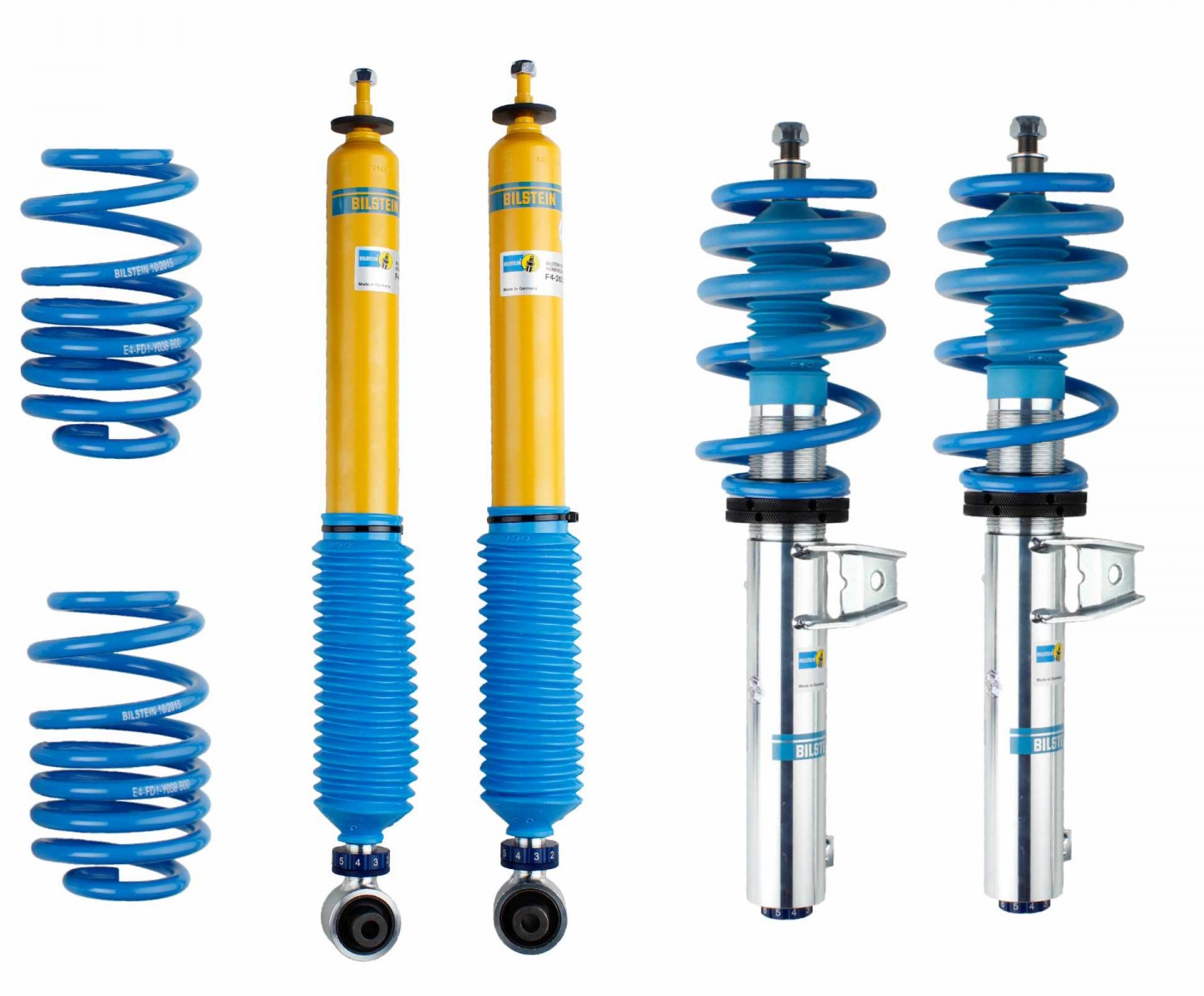
These parts cannot be judged in isolation. A low-friction damper is valuable only if its mounts and joints allow it to respond. A sophisticated multi-link axle can still steer unpredictably if its bushings deflect in the wrong direction. A soft main spring can ride harshly if the car spends too much time on its bump stops.
Why EVs change the calibration problem
The laws of suspension do not change for an electric car, but the design inputs often do.
A traction battery can alter total mass, axle-load distribution, yaw and pitch inertia, and the amount of structure available around the suspension. Converting an existing platform from combustion power to battery-electric drive can therefore require reassessment of wheel rate, damping, roll stiffness, travel, camber and toe rather than a simple spring-rate increase. SAE: reassessing suspension characteristics after EV conversion
Several EV characteristics deserve particular attention:
- A floor-mounted battery places substantial sprung mass low in the body. That can reduce the roll moment created by a given lateral acceleration, but it does not remove the need to control roll or tyre-load transfer.
- High vehicle mass increases the energy involved in body motion and the forces required to arrest it within finite travel. Mass alone, however, does not determine whether an EV will ride well.
- Strong drive torque and regenerative deceleration can make pitch calibration and changes in axle load more noticeable.
- Large wheels, wide tyres and large brakes can increase unsprung mass and tyre stiffness. Their effect must be evaluated as a complete wheel-and-tyre package.
- With little engine masking noise, impacts, damper hiss, tyre cavity noise and bushing inputs can be easier to hear.
- Adjustable ride height can protect the battery on poor roads or lower the body at speed, but any range benefit depends on the vehicle's aerodynamics, control strategy and energy used by the system.
The correct conclusion is not that every EV needs air or active suspension. It is that an EV-specific mass distribution, tyre package, structure and duty cycle require an EV-specific calibration.
How the five articles fit together
The hardware name on a specification sheet tells only part of the story:
- suspension layouts and wheel-control geometry explains wheel-control layouts, kinematics, compliance, alignment and packaging.
- suspension springs explains wheel rate, coil and air springs, anti-roll bars, travel and load support.
- suspension dampers explains force–velocity behavior, compression and rebound, passive valves and adaptive damping.
- active suspension separates self-levelling, semi-active damping, active roll control, preview control and fully active suspension.
Porsche's current Taycan is a useful illustration of why the layers must be separated: its standard system combines two-chamber air springs, continuously controlled two-valve dampers, double-wishbone front wheel control and a multi-link rear axle, while Porsche Active Ride adds hydraulic pumps that can generate wheel-specific forces. “Air,” “adaptive” and “active” describe different functions in that one chassis. Porsche: Taycan chassis, air suspension and Active Ride
How to assess an EV's suspension
A specification cannot reveal breakaway friction, damper curves, bushing behavior, available travel, tyre construction or software calibration. A careful road test should therefore isolate conditions rather than search for one vague impression:
- Check tyre size, type, pressure and load before comparing vehicles.
- Use the same drive mode and similar passenger or cargo load.
- Include sharp-edged joints, small repeated ripples, long undulations and a one-wheel disturbance.
- Notice whether the first impact is isolated and whether the body settles after it.
- Separate vertical harshness from side-to-side head toss and from noise.
- Check pitch consistency during normal regeneration and braking.
- On a safe road, assess whether steering correction is needed after a mid-corner bump.
- Try every suspension mode; a wider menu does not guarantee a wider or better-controlled operating range.
The best suspension for a buyer is not necessarily the softest or the most complex. It is the system that keeps its behavior predictable across the roads, temperatures, loads, tyres and speeds that the vehicle will actually encounter.