
Suspension springs: wheel rate, air systems and travel
Springs support the vehicle and store energy as the wheels move relative to the body. Their effect at the tyre depends on spring stiffness, installation geometry, tyre stiffness, anti-roll devices, auxiliary stops and the amount of travel available.
Spring rate and wheel rate
For an ideal linear spring:
F = k × x
F is force in newtons, k is spring rate in N/m and x is deflection in metres. The elastic energy stored at deflection x is:
E = ½kx²
A real suspension is normally described at the wheel. If spring displacement is a fraction r of wheel displacement, a simple frictionless approximation gives:
kᵥ ≈ kₛ × r²
Here kᵥ is wheel rate and kₛ is the component's spring rate. The square matters: moving a spring inboard or changing its lever geometry can alter wheel rate substantially without changing the spring itself. The motion ratio can also change through travel, adding geometric progressiveness.
Tyre vertical stiffness acts in series with the suspension, while bushings, mounts, anti-roll bars and bump stops add other elastic paths. That is why a spring-rate number alone cannot predict the ride described in EV suspension overview.
Coil springs
Most passenger EVs with steel suspension use helical coil springs. In a simplified close-coiled, round-wire spring:
k ≈ Gd⁴ / (8nD³)
G is the material's shear modulus, d is wire diameter, n is the number of active coils and D is mean coil diameter. End shape, pitch, stress correction, material, manufacturing process and packaging modify the real design, but the formula reveals why small geometric changes can produce large rate changes.
A constant-diameter, constant-pitch spring can be approximately linear over its working range. Variable wire diameter, coil diameter or pitch can create a rising rate as coils progressively become inactive. Finite-element and physical validation are needed because stress, contact and manufacturing constraints make nonlinear coil design more complex than the label “progressive spring” suggests. SAE: nonlinear design of passenger-vehicle coil springs
Coil springs are compact, durable and do not need a compressor, reservoir or pneumatic control system. Their static rate and free length are fixed, however. A vehicle designed for a wide payload range must accept more ride-height change or use self-levelling assistance.
Air springs
An air spring supports load through pressure acting over an effective area:
F ≈ (pᵢ - pₐ) × A_eff
Internal pressure pᵢ, ambient pressure pₐ, effective area A_eff, enclosed volume, bellows geometry and gas temperature all change as the suspension moves. Air-spring force is therefore nonlinear and dynamic. Heat transfer and the speed of compression influence its effective stiffness.
A complete passenger-car air-suspension system contains more than bellows. It can include a compressor, dryer, reservoir, valve block, pressure and height sensors, lines, filters, electronic control and a separate or integrated damper. Modelling and test work must include the pneumatic lines, valves and compressor when levelling time and pressure response matter. SAE: passenger-car air-suspension system modelling and validation
Air suspension enables three functions that should not be confused:
- Self-levelling adds or removes air to recover a target ride height after the static load changes.
- Selectable height raises the vehicle for clearance or lowers it for access, stability or aerodynamics.
- Variable spring characteristic changes pressure, effective volume or chamber connection to alter wheel rate.
Self-levelling is normally a relatively slow height-control task; it does not by itself make the suspension fully active.
Chamber count and effective volume
Some air springs connect multiple chambers through valves. Opening a chamber can increase the gas volume participating in a movement; closing it can reduce that volume. All else equal, a larger effective volume generally reduces the pressure change for a given displacement and can lower the dynamic rate. Bellows area, pressure, valve restriction and thermal behavior mean that chamber count alone is not a performance score.
The current Porsche Taycan provides a concrete production example. Its standard chassis combines two-chamber air springs with self-levelling and two-valve adaptive dampers. The body can lower at speed, while the spring and damper remain distinct control elements. Porsche: Taycan two-chamber air suspension
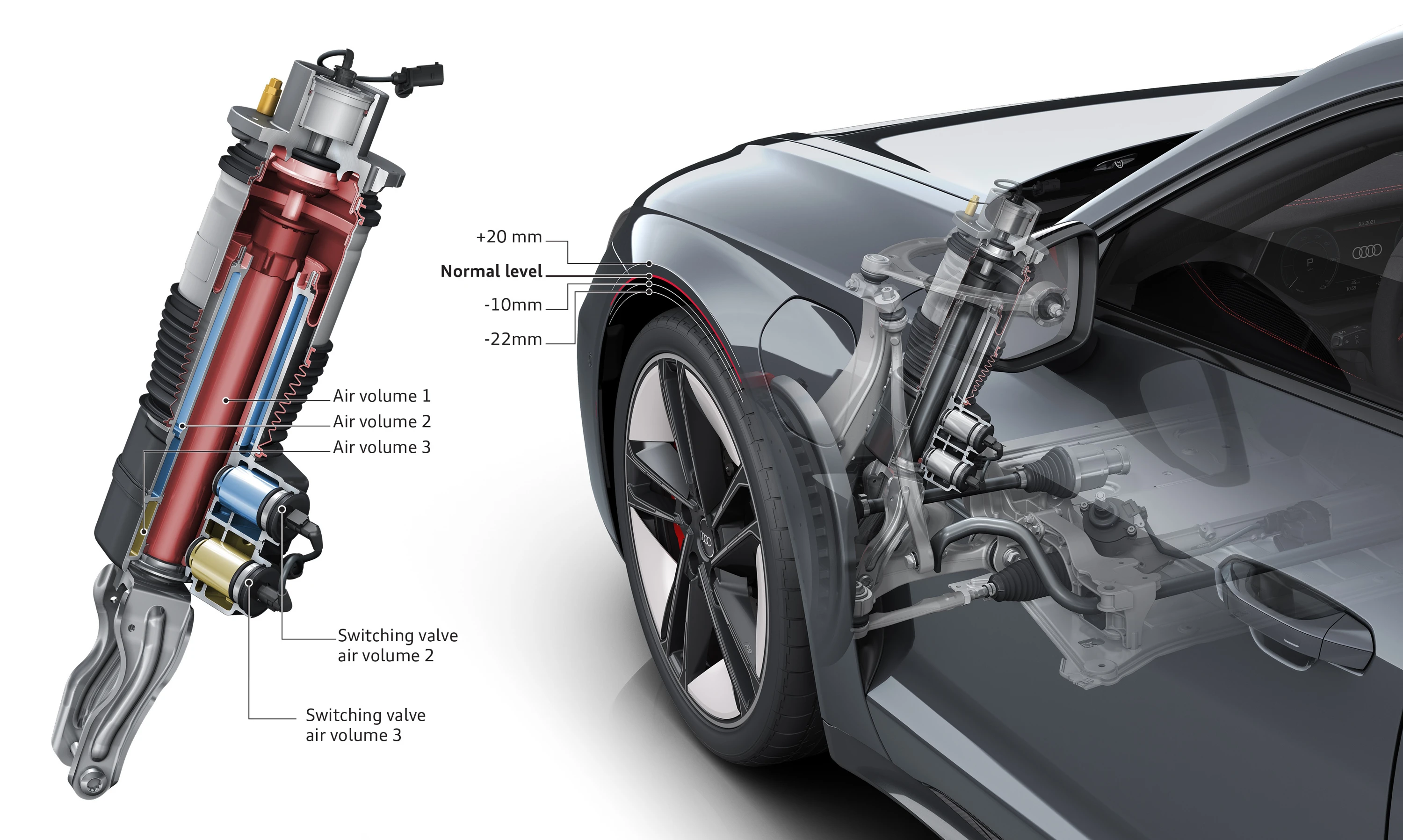
Air systems add mass, cost, seals and pneumatic failure modes. Repeated height changes can heat the compressor; leaks can leave one corner low; water management and cold-weather behavior matter. Service must follow the maker's procedure because an unpressurized bellows can be damaged if the vehicle is lowered onto it.
Torsion bars, leaf springs and composites
A torsion bar is a straight spring that stores energy by twisting. Its lever sets the relationship between wheel movement and bar twist. Torsion bars can package longitudinally or transversely and can make ride-height adjustment mechanically convenient, but they still need separate wheel-location links and dampers.
A leaf spring bends along its length. In a dependent axle it can support the body and also transmit longitudinal and lateral loads, reducing part count. Interleaf friction, shackle geometry and a rate chosen for payload can make unladen ride difficult to tune, but parabolic, composite and multi-stage designs expand the available behavior.
Composite springs can reduce mass and corrosion, and a single transverse composite spring can serve both wheels in some layouts. Material anisotropy, damage inspection, attachments and replacement strategy must be engineered for the exact application.
Anti-roll bars and interconnected springs
An anti-roll bar is a torsion spring linking the left and right suspension. When both wheels rise together, an ideal symmetric bar rotates without much twist. When one rises relative to the other, the bar twists and adds roll stiffness.
This allows engineers to change the distribution of roll stiffness between axles without increasing the main springs by the same amount. That distribution influences steady-state handling balance and how lateral load transfer is shared between the front and rear tyres.
A stiff passive bar also couples the wheels over one-sided bumps. Disconnecting bars, active roll systems and hydraulic or pneumatic cross-links can vary that coupling, but these are different technologies with different energy and failure behavior. See active suspension.
Bump stops, rebound stops and usable travel
The main spring is not the only spring in the last part of the stroke. A jounce bumper, commonly called a bump stop, adds rapidly increasing force near compression limit. Modern elastomeric stops are tuned components whose shape and material control progressive stiffness, energy absorption and noise. SAE: progressive suspension bump-stop behavior
A rebound stop performs a related task near full extension. Both protect components and help shape extreme-motion behavior, but frequent stop contact can make a vehicle feel abrupt or can lift load from a tyre.
Usable travel has two sides:
- Bump travel absorbs road rises and body compression.
- Rebound travel lets the wheel follow dips and allows body extension.
Lowering a vehicle without preserving both can cause earlier stop contact, change motion ratios and alignment, and leave the damper operating in the wrong part of its stroke. A very soft nominal spring is not comfortable if normal loads consume the travel it needs.
Load, natural frequency and ride height
Adding load compresses a steel spring by approximately Δx = ΔF/k in its linear range. It also changes the sprung mass in the natural-frequency relationship. Passenger and cargo load can therefore alter ride height, alignment, headlamp aim, travel and body response.
An air system can restore ride height by increasing pressure, but that does not make the loaded and empty vehicle dynamically identical. Tyre load, inertia, damper demand and structural deflection still change.
Ride height also affects driveshaft angles, suspension geometry and aerodynamics. A claim that lowering improves range needs vehicle-specific evidence: drag may fall, but tyre alignment, cooling flow, underbody clearance, compressor energy and control conditions also matter.
EV-specific spring choices
Battery mass and packaging can narrow the engineer's options. A floor battery may leave limited space for long arms or deep spring seats, while battery protection requires adequate ground clearance and compression travel. Large changes between empty, fully occupied and towing load can make self-levelling attractive.
The correct steel-spring response to extra mass is not automatically “make it stiffer.” Engineers can also change motion ratio, travel, progressive stops, anti-roll distribution, damping, tyre construction or the location of mass. Air suspension is likewise not automatically softer; its pressure, volume, piston shape and damper calibration determine the result.
What buyers and owners should check
For an air-suspension option, determine whether it provides self-levelling, driver-selectable height, multiple chambers, adaptive damping or active force generation. Those functions are often bundled but are not synonyms.
For any suspension, check behavior with the actual wheel size and expected load. Look for sufficient ground clearance, controlled stop contact, stable towing height where applicable, and a smooth transition between primary spring and bump stop. On an older vehicle, unequal ride height can result from a broken or sagged coil, an air leak, a height-sensor fault, bush preload or accident damage; it should be diagnosed rather than masked with alignment alone.
Springs define how force grows with displacement. Comfort and control emerge only after geometry, dampers, tyres and available travel are added to that curve.