
Structural safety
Structural safety is controlled deformation. The body must absorb and redirect crash energy outside the cabin, preserve usable survival space, and keep the restraint system and high-voltage battery within their design limits.
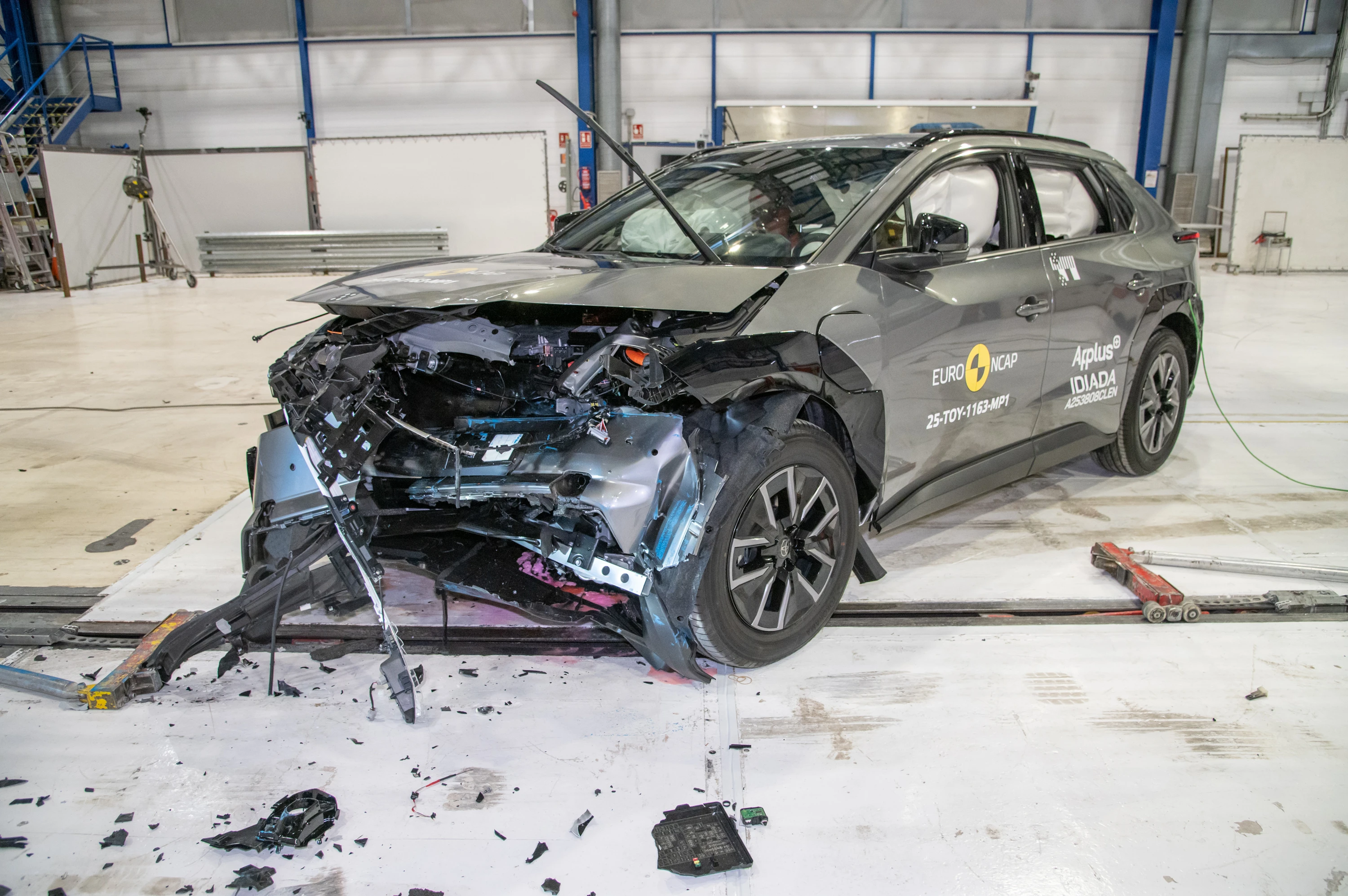
Stiff where needed, deformable where useful
A safe body is not simply the stiffest one. Front and rear crush structures need to deform progressively so the vehicle changes speed over more time and distance. Around the occupants, the passenger cell needs enough strength to limit intrusion and keep doors, seats, belts, and airbags in useful positions.
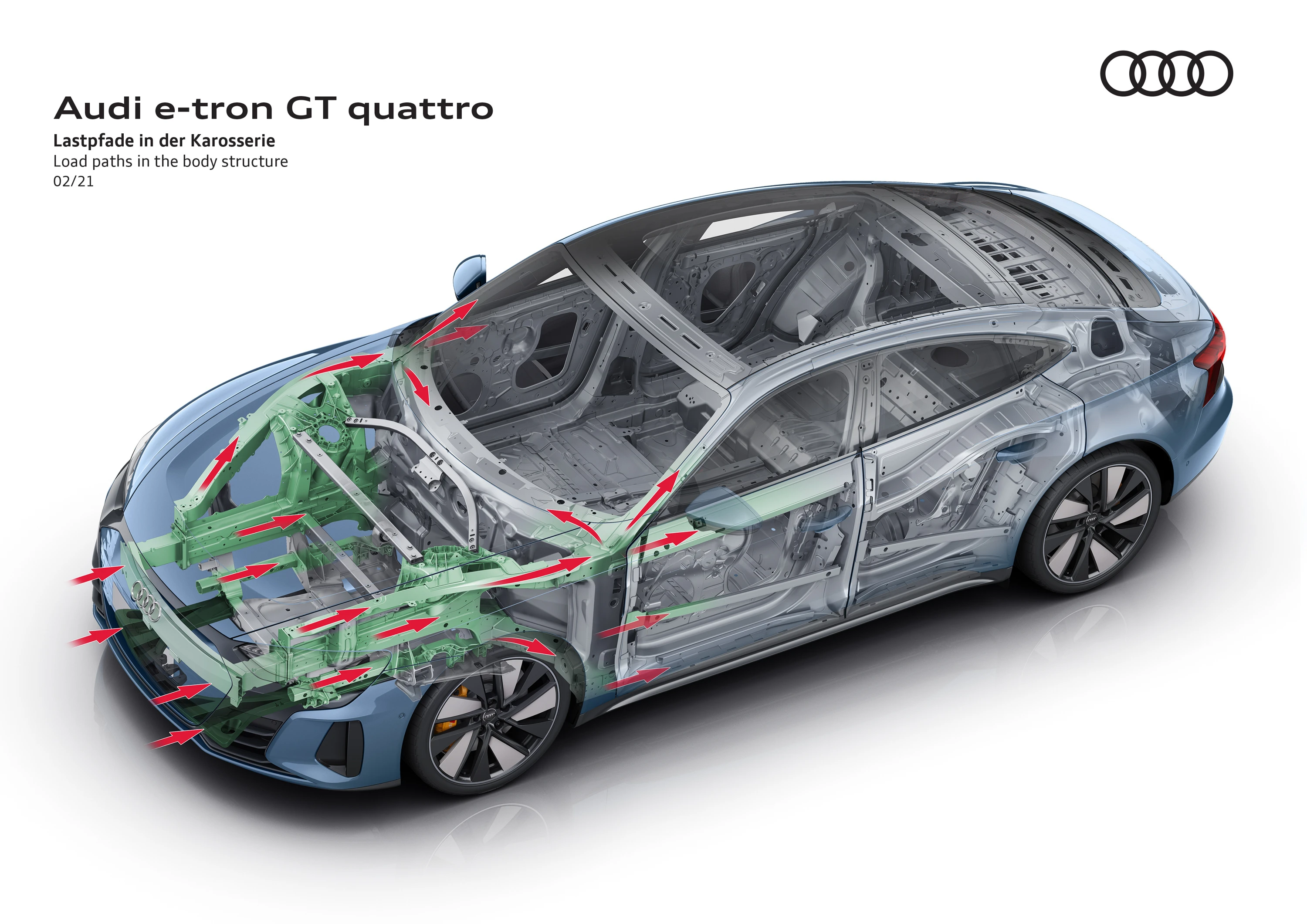
Engineers create multiple load paths through longitudinal rails, subframes, sills, cross-members, pillars, roof rails, and the floor. Different paths engage in full-overlap, moderate-overlap, small-overlap, side, rear, pole, rollover, and underride-type crashes. A design that performs well in one direction can still have a weakness in another.
The main jobs are:
- Manage the crash pulse: deform progressively rather than stopping the occupant compartment abruptly.
- Preserve survival space: limit movement of the steering column, pedals, dashboard, doors, roof, and floor into the cabin.
- Support the restraints: keep belt anchorages, seats, and airbag deployment zones in the positions used for calibration.
- Protect other road users: manage compatibility with vehicles of different size and mass and reduce harmful exterior contact for pedestrians and cyclists.
Side impacts and occupant space
Side impacts leave little crush distance between the striking object and the occupant. The sill, B-pillar, roof rail, door beams, floor cross-members, seat structure, and side airbags must share the work. Pole tests concentrate force into a narrow area, while far-side tests examine movement toward the centre of the vehicle.
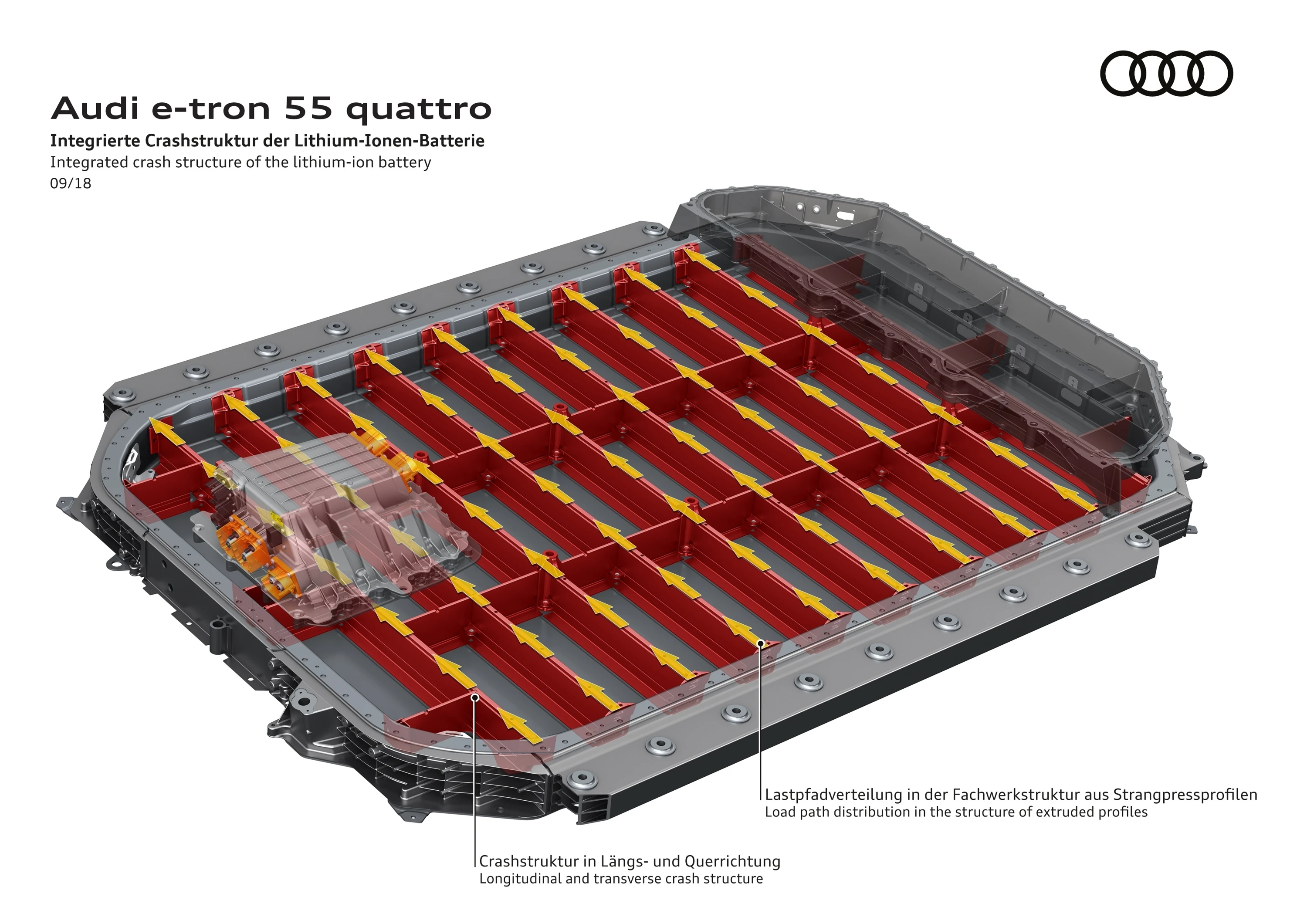
Side structure is especially important in a skateboard-style EV because the battery pack normally fills much of the floor between the axles. The design must limit both cabin intrusion and deformation of the pack enclosure.
Protecting the traction battery
The battery enclosure is part of a layered protection system. Depending on the platform, it may be a removable assembly or contribute more directly to body stiffness. Surrounding sills and cross-members route side loads, underbody shields resist road debris, and pack rails and enclosure sections control local deformation.
Mechanical protection is only one layer. The battery-management system monitors cells and insulation, while contactors or pyrotechnic devices can disconnect the high-voltage bus after a qualifying crash. Regulations address electrical shock, electrolyte leakage, fire, mechanical integrity, vibration, temperature, and thermal-propagation risks. Battery safety covers those battery-level protections in detail.
Pack intrusion is not the only measure that matters. A damaged cell can develop an internal short circuit without obvious external deformation, and a vehicle that has been in a severe underbody or side impact may need isolation, inspection, and monitoring according to the manufacturer's emergency and repair procedures.
How EV architecture changes the problem
An EV platform gives engineers different opportunities and constraints:
- The absence of a combustion engine can free front-end volume, but steering, suspension, HVAC, charging, power electronics, and crash structures still compete for space.
- A low-mounted pack usually lowers the centre of gravity, which can reduce rollover propensity, but roof strength and occupant containment remain necessary.
- The pack and its enclosure can add floor stiffness, but the result depends on how the body and pack are connected and how loads are transferred.
- EVs are often heavy for their exterior size. More mass can protect occupants in a collision with a lighter vehicle while increasing the forces imposed on the other vehicle, so crash compatibility matters.
- The flat floor can change seating position and under-thigh support, which the belt, seat, and airbag calibration must accommodate.
These are engineering inputs, not proof that every EV is safer than every combustion vehicle. The outcome must be checked for the exact model.
Mercedes-Benz structural-safety development and testing. Mercedes-Benz / YouTube.
Materials and manufacturing
Modern bodies mix mild steel, advanced and press-hardened steels, aluminium castings and extrusions, adhesives, spot welds, rivets, and tailored blanks. Material grade is chosen for a local job: controlled folding, high-strength reinforcement, joint stability, corrosion performance, manufacturability, or repair.
Large cast sections and structural battery concepts can reduce part count and change load paths, but neither is automatically safer. Joint design, casting quality, crack behaviour, redundancy, replaceable crash boxes, and the complete tested structure determine performance.
Computer simulation lets engineers study many impact configurations before physical prototypes exist. Physical component, sled, barrier, pole, and vehicle-to-vehicle tests remain essential because models must be correlated against real materials, joints, dummies, and failure modes.
What crash tests reveal
A crash-test video can look dramatic even when the structure performs as intended. Useful evidence includes the measured crash pulse, intrusion at the footwell and pillars, door-aperture deformation, dummy injury measures, restraint interaction, battery condition, and whether doors and emergency systems work after impact.
Small-overlap tests are particularly revealing because the impact can miss the main front rails. IIHS reports that vehicles with good performance in its driver-side small-overlap evaluation have shown lower driver fatality risk in real-world frontal crashes than poor-rated vehicles.
1959 Chevrolet Bel Air versus 2009 Chevrolet Malibu crash test. IIHS / YouTube.
1998 Toyota Corolla versus 2015 Toyota Corolla car-to-car crash test. Global NCAP / YouTube.
The comparison videos also show why vehicle age matters. Stronger occupant compartments, improved load paths, and coordinated restraints have changed crash outcomes substantially, but results from different masses and test configurations still need careful interpretation.
Repairability is part of the design
After a collision, safe repair means restoring load paths, joints, corrosion protection, sensor mounting points, and battery isolation—not merely making the exterior look straight. Some designs use replaceable crash boxes or sectional repair procedures; others require replacement of a large casting, rail, or pack enclosure.
Before buying or repairing a damaged EV, check the manufacturer's structural repair manual, high-voltage procedure, measurement requirements, adhesive and fastener specifications, and sensor-calibration instructions. A poor repair can compromise both passive safety and ADAS performance.
See Seat belts and Airbags for the restraints supported by the body, and Crash testing and safety ratings for the tests used to assess the complete vehicle.