
EV wheels and tires: fitment, range, grip, noise, and wear
A wheel-and-tire package determines how an EV carries load, generates grip, absorbs sharp road inputs, and spends energy at the road. The right choice is not simply the largest wheel or a tire carrying an “EV” label: every dimension, load rating, construction, pressure, and seasonal capability must work as one approved system.

Lotus Eletre with large-diameter wheels
The wheel-and-tire system
The wheel is the rigid structure bolted to the hub. Its rim provides the tire’s bead seats; its center section transfers braking, cornering, and drive forces between the rim and the hub. The tire is a pressurized, flexible composite of rubber compounds, textile or steel reinforcement, beads, belts, and an airtight inner liner. Neither part can be assessed safely in isolation.
Wheel anatomy and fitment
A wheel must match more than rim diameter. A correct fit also requires the approved rim width and profile, bolt pattern, center bore, offset, fixing hardware and seat type, load capacity, brake clearance, suspension clearance, and space inside the wheel arch. UN Regulation No. 124 covers approval and structural testing of replacement wheels for passenger cars in markets applying it. UNECE: UN Regulation No. 124 — replacement wheels for passenger cars
A marking such as 8.5J × 20 ET45 describes an 8.5-inch nominal rim width, a specified flange profile, a 20-inch rim diameter, and 45 mm of positive offset. Offset is the distance between the wheel centerline and its hub-mounting face. Changing it moves the tire inboard or outboard and can alter clearance, steering geometry, bearing loads, scrub radius, and how loads enter the suspension. A spacer changes effective offset and also changes the fixing arrangement; it is not a harmless cosmetic adjustment.
Wheel load rating matters on any car and deserves particular attention on a heavy EV. The wheel must support the vehicle’s permitted axle loads with the correct safety margin, not merely fit over the hub. Correctly rated bolts or nuts, the right seat geometry, clean mating faces, and the specified tightening sequence and torque are part of the installation.
Cast, flow-formed, and forged aluminum wheels use different manufacturing routes, while some vehicles use steel, magnesium, or composite components. Manufacturing label alone does not establish strength or weight. Design, material, testing, quality control, and load rating determine the result.
Open spokes, aero covers, and brake cooling
Wheel openings affect both airflow and heat rejection. Open designs can expose the brakes to cooling air, while smoother faces and aero covers can reduce flow disturbance around the rotating wheel. The best design depends on the complete vehicle: a closed-looking wheel is not automatically efficient, and an open wheel is not automatically well cooled. Wheel rotation, tire shape, wheel-arch pressure, body flow, brake demand, and the two sides of the car all interact. SAE research on the Tesla Model S showed that wheel and tire aerodynamics can make a meaningful contribution to vehicle drag. SAE: aerodynamic development of the Tesla Model S wheel

Porsche Taycan with a split-spoke wheel design

Tesla Model Y with aerodynamically shaped wheel covers

Mercedes-Benz EQS with an eleven-spoke wheel design
EVKX explains the brake system separately in EV brakes. A wheel change must preserve the clearances and airflow required by that exact brake package.
The tire is also a spring
The tread supplies the rubber and pattern that meet the road. Belts stabilize the tread area, the carcass carries tension, the beads anchor the tire to the rim, the sidewall permits controlled deflection, and the inner liner retains air. The pressurized air carries most of the load; the structure contains that pressure and transmits forces.
This makes the tire the first spring and damper in the suspension path. Its pressure, construction, sidewall height, load, and temperature affect impact harshness, steering response, grip, and the wheel’s motion over rough surfaces. A lower-profile tire can sharpen response and create room for a larger brake, but it leaves less deflection and geometric margin between a pothole and the rim. See EV suspension for the wider relationship between tire stiffness, unsprung mass, wheel control, and ride comfort.
Reading tire markings and labels
A common sidewall service description might read 235/45 R19 99V XL:
235is the nominal section width in millimeters, measured under specified conditions rather than the tread width.45is the nominal sidewall aspect ratio: sidewall height is 45% of section width.Rmeans radial construction; it does not mean radius.19is the rim diameter code in inches.99is the load index. It maps to a maximum load in the applicable standard under specified pressure and operating conditions.Vis the speed symbol. It is a tested capability under specified load and pressure, not permission to drive at that speed.XLmeans Extra Load or reinforced construction. It does not mean run-flat.
Some high-load tires carry an HL prefix before the size. HL, XL, and the numeric load index are not interchangeable marketing grades; the vehicle placard and manufacturer documentation establish what the car requires. UN Regulation No. 30 defines passenger-car tire markings, dimensions, load indices, speed symbols, and performance requirements in markets applying it. UNECE: UN Regulation No. 30 — tyres for passenger cars The ETRTO standards manual adds the load-versus-pressure and rim relationships used for standard-load, XL, and HL tires. ETRTO 2024 Standards Manual: passenger-car tyre sizes, loads, pressures, XL, and HL
Other sidewall information can identify the manufacturer, model, production plant, type approval, direction of rotation, intended inside and outside faces, original-equipment specification, run-flat or self-sealing construction, and date code. A directional arrow and an asymmetric outside marking solve different problems and must both be respected when applicable.
Seasonal markings
“Summer,” “all-season,” “all-weather,” and “winter” are market descriptions, not globally harmonized guarantees of the same performance. Tread compound and pattern must suit the temperatures, water, snow, and ice the vehicle will encounter.
The M+S marking is based on a category or design declaration in many regulatory systems. The three-peak mountain snowflake, or 3PMSF/Alpine symbol, requires a standardized severe-snow performance test under UN Regulation No. 117. It establishes a minimum tested level on snow; it does not rate wet braking, dry handling, or ice grip. Studded-tire rules and winter-tire laws vary by country and sometimes by road or season. UNECE: severe-snow performance and the 3PMSF Alpine symbol
What the EU tire label does—and does not—tell you
The current EU label reports:
- rolling-resistance class from A to E;
- wet-grip class from A to E;
- measured external rolling noise in dB and a noise class;
- severe-snow and severe-ice symbols when applicable;
- a QR code leading to the tire’s EPREL product record.
These are standardized comparisons, not a complete tire test. The external-noise value describes pass-by noise, not noise heard in the cabin. The label does not grade dry braking, steering response, aquaplaning across every water depth, ride comfort, impact resistance, tread life, repairability, or performance on a specific EV. Rolling resistance, wet grip, noise, and wear can also pull the design in different directions. European Commission: tyre label, rolling resistance, wet grip, and noise
UN Regulation No. 117 provides the type-approval framework for rolling sound, wet adhesion, rolling resistance, and severe-snow performance. UNECE: UN Regulation No. 117 — rolling resistance, rolling noise, wet grip, and snow performance ISO 28580 specifies a controlled laboratory method for comparing the steady-state rolling resistance of new, free-rolling tires. A label class therefore does not predict one exact range change on every road, temperature, pressure, or vehicle. ISO 28580:2018 — tyre rolling-resistance measurement
In the United States, the Uniform Tire Quality Grading system reports treadwear, traction, and temperature grades for covered passenger tires. Those grades answer different questions from the EU label and should not be treated as equivalent scales. NHTSA TireWise: tire selection, pressure, markings, wear, and maintenance
What is different for an EV
EVs do not change tire physics, and there is no single regulatory class called an “EV tire.” A conventional tire can be entirely suitable for an EV when its approved size, load capacity, speed capability, construction, and performance fit the vehicle. An EV-branded tire may combine several useful design choices, but the branding itself certifies none of them.
Load and torque
A traction battery can increase vehicle and axle mass, although the difference varies widely by segment and vehicle design. The correct response is to meet the specified load index and pressure—not to assume that every EV needs the stiffest available tire. Some applications require XL or HL construction; others do not.
Electric motors can change wheel torque quickly, but “instant torque” does not by itself determine tire life. Actual tread stress depends on requested acceleration, torque control, driven axle or axles, tire load, slip, road texture, temperature, pressure, alignment, and compound. Smooth driving can be gentle on tires; repeated hard launches and high cornering loads accelerate wear regardless of powertrain.
Efficiency, grip, and wear
Tire deformation dissipates energy as heat. Low rolling resistance can extend range, especially at lower speeds where aerodynamic drag is smaller, but it is only one design target. A tire must still provide wet and dry grip, stable handling, load capacity, damage resistance, acceptable wear, and suitable winter behavior. The EU label deliberately places rolling resistance and wet grip side by side because optimizing one property does not guarantee the other. European Commission: tyre label, rolling resistance, wet grip, and noise
Noise and puncture-mobility technologies
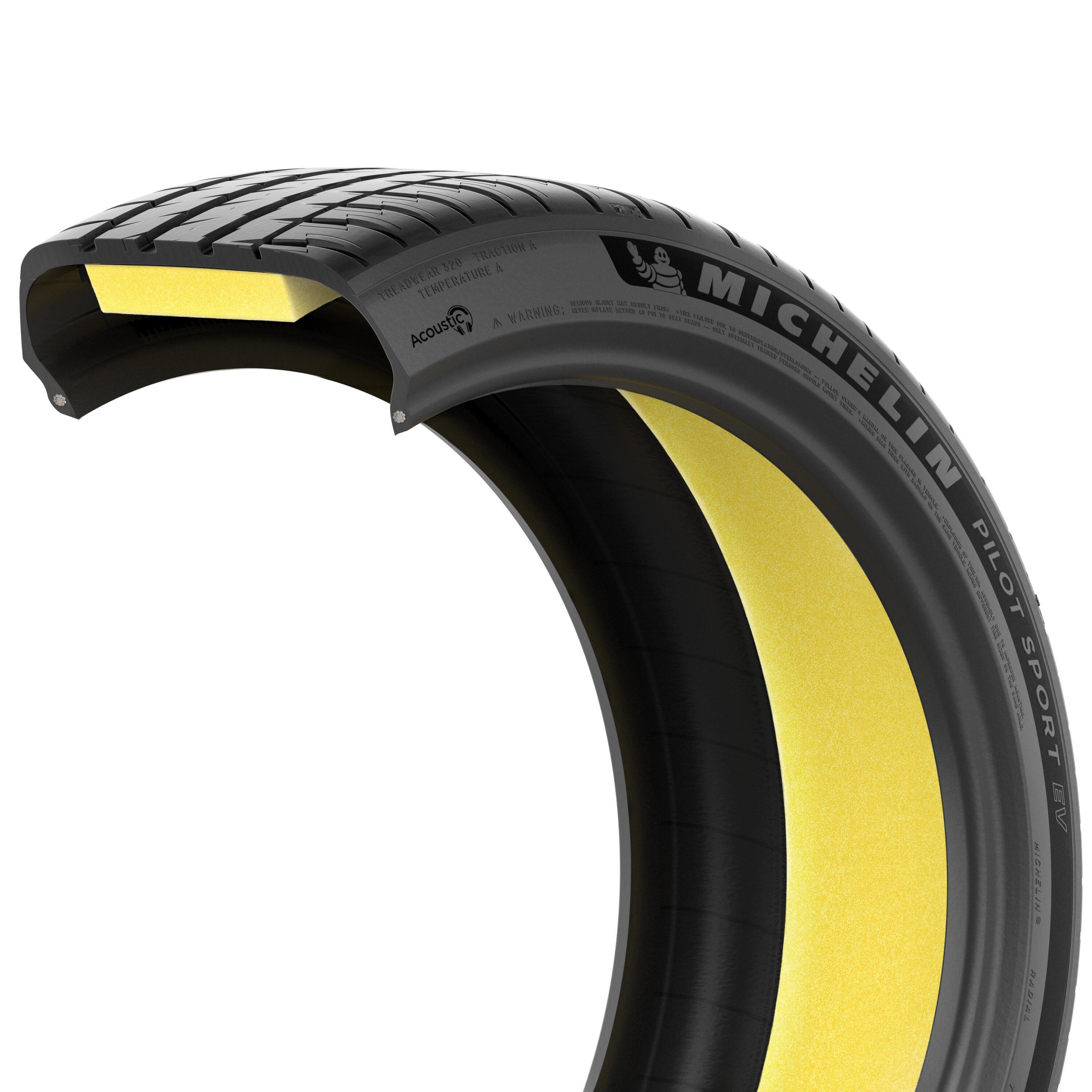
Removing combustion-engine masking makes some tread, impact, and tire-cavity noise easier to hear. Pattern design, compound, carcass, wheel structure, suspension paths, body insulation, and road surface all affect cabin noise. A foam strip bonded inside a tire targets a narrow cavity resonance; it does not make every road surface quiet and does not seal a puncture. Research on tire-cavity modes shows why the tire, enclosed air, wheel, and vehicle structure must be treated as a coupled system. SAE: tire acoustic-cavity modes and in-cabin noise
Run-flat construction, acoustic foam, factory-applied sealant, and a roadside inflation kit perform different functions:
- Run-flat or self-supporting construction is designed for limited mobility after pressure loss, subject to the tire maker’s speed and distance limits.
- Acoustic foam absorbs part of the cavity resonance and may require a specific repair procedure.
- Self-sealing tires use sealant inside the tread area to slow or stop air loss from some small penetrations.
- A sealant-and-compressor kit is a temporary roadside measure and can have limits for damage size, temperature, pressure monitoring, and later repair.
A Kia service procedure for foam-lined EV6 tires, for example, permits specified tread repairs after foam is removed locally and the tire is internally inspected. That is evidence for that construction and procedure, not a rule for every foam-lined tire. Kia service bulletin: EV6 foam-lined tire repair procedure
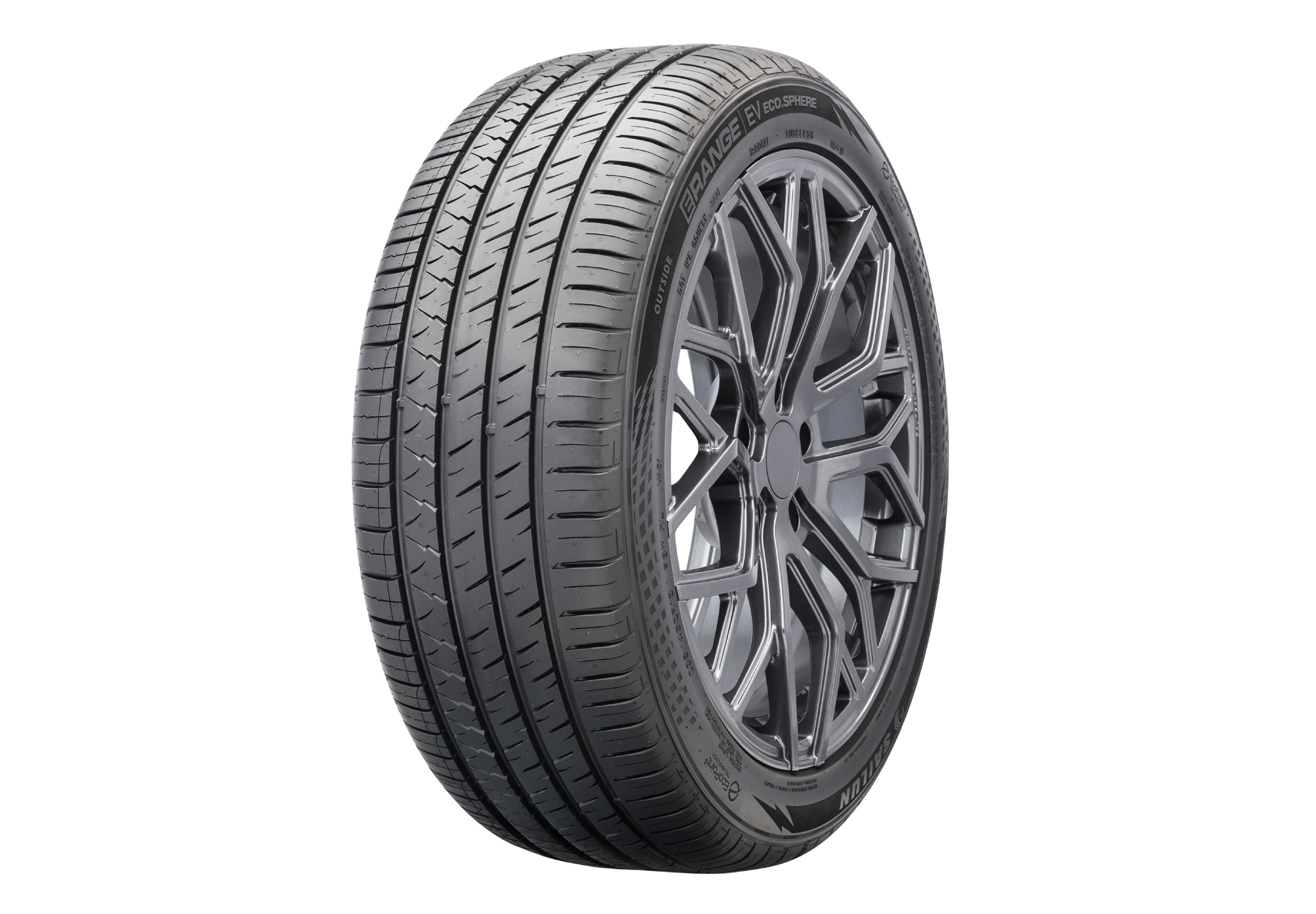
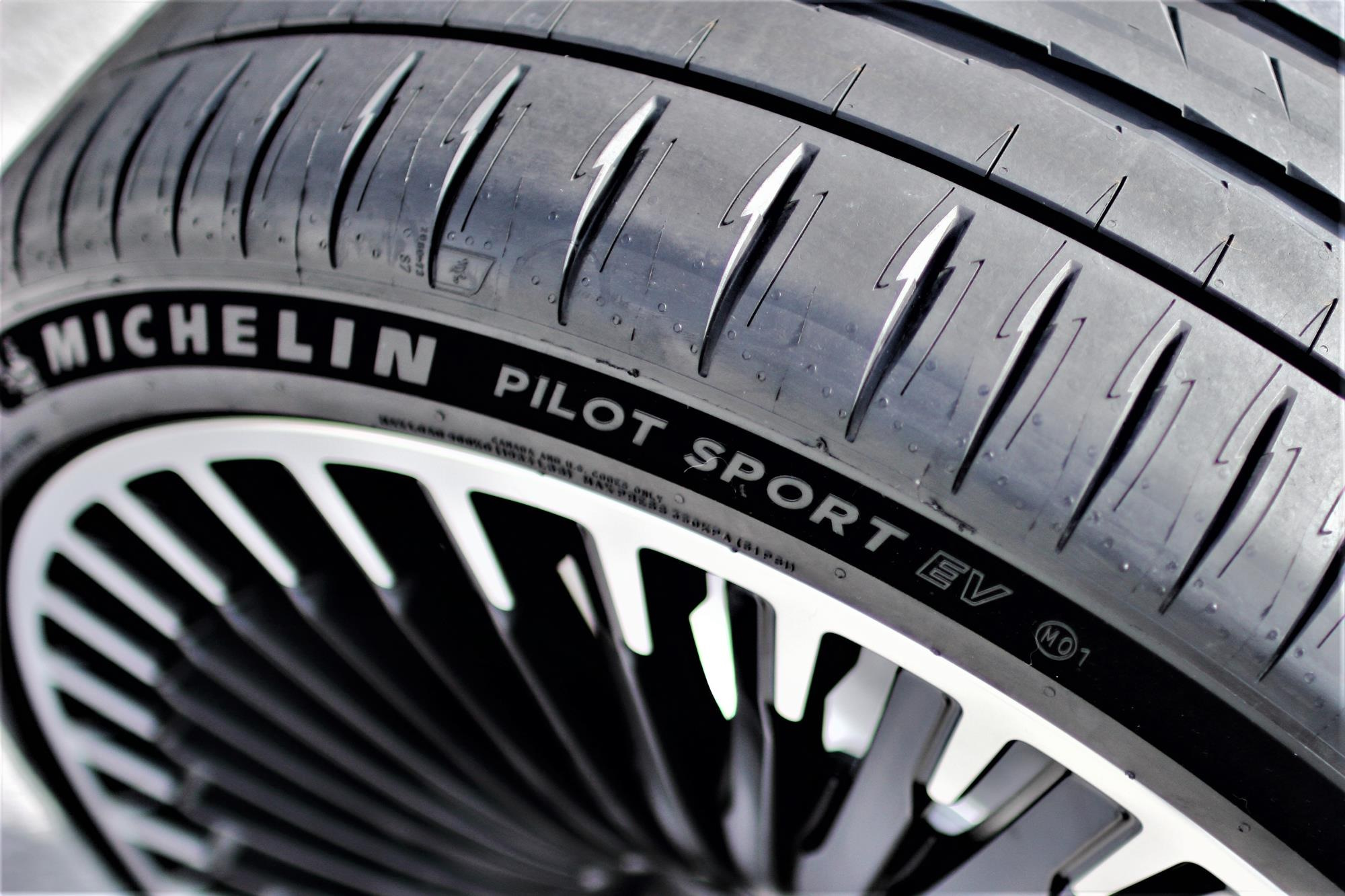
The products pictured below illustrate EV-oriented tread and noise-control designs. Buyers should compare their exact size, service description, label results, seasonal category, and vehicle approval rather than relying on the EV name.
How the package affects range, ride, and handling
Rolling resistance
A useful first approximation is:
Fᵣᵣ ≈ Cᵣᵣ × m × g
Pᵣᵣ = Fᵣᵣ × v
Here Cᵣᵣ is the rolling-resistance coefficient, m is supported mass, g is gravitational acceleration, and v is road speed. The equations explain why more load and more speed increase the power needed to overcome rolling resistance in this simplified model. Real Cᵣᵣ changes with construction, pressure, temperature, speed, load, road texture, water, and tire condition. EV simulation research likewise identifies road properties, temperature, speed, and inflation pressure as material inputs. SAE: tire-road rolling resistance in electric-vehicle systems
Regenerative braking cannot recover rolling-resistance losses: that energy has already become heat in the tire and road. It can recover part of the vehicle’s kinetic energy during deceleration, which is a different term in the energy balance.
Aerodynamic drag
At road speed, exposed rotating tires, wheel openings, wheel-arch flow, and sidewall shape affect drag. A smoother wheel face or well-developed cover can help, but the result belongs to the complete car. It must be balanced against crosswind behavior, brake cooling, contamination, and durability. Removing an original aero cover or fitting a wider, more outboard package can change consumption even when the tire’s rolling-resistance label is unchanged.
Diameter, width, and sidewall height
Increasing rim diameter while keeping approximately the same tire outer diameter is often called plus sizing. It normally pairs a larger wheel with a lower aspect ratio. Minus sizing uses a smaller approved wheel and taller sidewall, often for winter use. Either change still needs an approved tire size, wheel width, load rating, offset, brake clearance, and pressure.
The nominal unloaded tire diameter can be estimated from its size:
diameter ≈ 25.4 × rim diameter + 2 × section width × aspect ratio / 100
For 235/45 R19, the estimate is about 694 mm. It is only a geometric approximation. Actual dimensions vary with the tire design, measuring rim, pressure, load, temperature, and wear, while loaded and rolling radii differ from the unloaded value.
A changed rolling circumference affects distance per wheel revolution. Outside the vehicle’s approved combinations, that can disturb the speedometer, odometer, range calculation, anti-lock braking, stability control, traction control, all-wheel-drive logic, and driver-assistance calibration. Similar outside diameter is necessary but not sufficient for safe fitment.
Width is also not a one-directional performance control. A wider tire may support a different compound, carcass, and contact-patch shape, but it can add aerodynamic drag, mass, water-displacement demand, and steering sensitivity. Narrower does not automatically mean lower rolling resistance or better snow grip. Compare complete tires in the exact approved size.
Mass and rotational inertia
Wheel-and-tire mass is partly unsprung and also rotates. Lower unsprung mass can help the suspension follow short road inputs, but the outcome depends on tire stiffness, wheel strength, damping, geometry, and road frequency. Rotational kinetic energy depends on mass distribution through E = ½Iω²; a kilogram near the rim matters more to inertia than a kilogram near the hub.
This does not justify a universal “one kilogram equals one kilometer of range” rule. Forging, rim diameter, tire construction, aero covers, and width can move mass and drag in different directions. In steady highway driving, aerodynamics and rolling resistance usually matter more than repeatedly accelerating wheel inertia; in stop-and-go driving, mass and inertia appear more often, while regeneration returns only part of the kinetic energy.
Square and staggered packages
A square package uses the same wheel and tire size at all four corners. A staggered package uses different front and rear widths, and sometimes different diameters. Staggering can support axle-specific load, traction, steering, aero, or packaging targets, but it can restrict tire rotation and complicate replacement.
The Lucid Air Sapphire is one production example: Lucid specifies 20-inch front and 21-inch rear wheels with axle-specific tire sizes and removable aero discs. Lucid: Air Sapphire wheel, tire, and aero-disc specifications It is not the only EV with mixed wheel diameters, and its package should not be generalized to other Air variants.

Lucid Air Sapphire with 20-inch front and 21-inch rear wheels
Choosing a replacement or alternative package
Start with the tire-information placard, owner’s manual, certificate of conformity or equivalent market documentation, and the manufacturer’s approved wheel-and-tire combinations. The sidewall’s maximum pressure is not the vehicle’s inflation recommendation.
The fitment gate
Before comparing brands or styling, confirm all of the following:
- exact front and rear tire sizes, including any stagger;
- required load index and any Standard Load, XL, or HL construction;
- required speed symbol and seasonal restrictions;
- wheel diameter, width, contour, offset, bolt pattern, center bore, and load rating;
- brake, suspension, body, sensor, and snow-chain clearance;
- correct bolts or nuts, seat type, thread engagement, and tightening specification;
- TPMS compatibility and any registration or relearn procedure;
- approved cold pressures for normal and fully loaded use;
- whether the tire needs a directional, asymmetric, original-equipment, run-flat, acoustic, or self-sealing specification.
An original-equipment code can identify a version developed for a particular vehicle maker. Two tires with the same product family and nominal size can differ in construction or tuning. The safest default is the exact approved specification; any substitution should be supported by the vehicle and tire manufacturers or a qualified fitment authority.
Match the tire to the job
Decide which conditions carry the greatest consequence:
- frequent rain and standing water;
- snow, ice, or sustained cold;
- rough roads and potholes;
- long high-speed motorway travel;
- heavy passenger, cargo, or towing loads;
- cabin-noise sensitivity;
- efficiency and range;
- steering response or track use;
- availability, repair support, warranty, and replacement cost.
Do not buy from a single metric. An A-rated rolling-resistance result cannot compensate for the wrong load index or unsuitable winter performance. A high treadwear grade does not prove short wet braking. A quiet external-noise label does not prove a quiet cabin.
If only two tires are replaced, USTMA recommends placing the pair with greater tread depth on the rear axle to reduce the risk of oversteer on wet roads. All-wheel-drive vehicles may impose tighter circumference or tread-depth matching rules, and staggered packages may prevent normal front-to-rear rotation. Follow the vehicle maker’s instructions before replacing fewer than four. USTMA: tire replacement and replacing fewer than four tires
Pressure, wear, damage, and repair
Pressure and TPMS
Check pressure when the tires are cold and use the vehicle maker’s value for the fitted size and load condition. Do not bleed a warm tire down to the cold target merely because pressure rose during driving. Pressure changes with temperature, and a recurring loss requires investigation.
TPMS is a warning system, not a maintenance gauge. A warning may appear only after significant underinflation; an indirect system may not show a numerical pressure and can miss equal losses across several tires. NHTSA advises monthly cold-pressure checks and identifies the vehicle placard—not the maximum molded on the tire—as the correct source. NHTSA TireWise: tire selection, pressure, markings, wear, and maintenance
Read the wear pattern
Measure tread across the full width and inspect both visible and inner sidewalls. The pattern is diagnostic:
- wear on both shoulders can indicate underinflation or repeated high deflection;
- center wear can accompany excessive pressure for the load, although construction and duty cycle also matter;
- one-sided or feathered wear points toward alignment, bushing, ride-height, or load issues;
- cupping can involve imbalance, damping, looseness, or runout;
- localized flat spots can follow wheel lock, long storage, or a structural problem.
Rotation can even out axle-specific wear only when wheel sizes, tire direction, and the vehicle maker allow it. Balancing addresses mass distribution around the assembly; alignment controls wheel angles. One cannot substitute for the other.
Replace or professionally inspect a tire for exposed cords, a bulge, deep cracking, a cut, repeated pressure loss, impact damage, severe irregular wear, or vibration. Tread-depth law varies by market, and a tire can become unsuitable for heavy rain or snow before reaching the legal minimum. The date code records manufacture, not a universal expiry date; age decisions also depend on storage, heat, sunlight, use, damage, and manufacturer guidance.
Punctures and roadside sealant
A plug inserted from outside is not a complete permanent repair. USTMA’s passenger-tire procedure limits repair to certain small punctures in the tread area, requires the tire to be removed for internal inspection, and uses both a stem to fill the injury and a patch to seal the inner liner. Shoulder, sidewall, run-flat, overlapping, or larger damage can make a tire non-repairable, while run-flat, self-sealing, and foam-lined products may add manufacturer-specific limits. USTMA: passenger-tire puncture repair procedure
After using roadside sealant or driving with very low pressure, tell the technician exactly what happened. The tire may look inflated while its inner liner, carcass, foam, sealant layer, valve, or TPMS sensor needs inspection.
Do EVs always wear tires faster?
No single multiplier applies. Vehicle mass, axle load, available torque, tire design, pressure, alignment, road surface, temperature, cornering, and driver inputs all influence wear. Some EVs can wear a performance tire quickly; a gently driven EV on a durable, correctly loaded tire may not. Claims that EVs universally consume tires at a fixed higher rate overstate the evidence.
The environmental issue is real even though the exact EV-versus-combustion comparison remains uncertain. Tire wear releases material to air, road, soil, and water. An OECD review found that direct public evidence isolating EV tire wear was limited and that vehicle comparisons are confounded by mass, segment, tire, range, and performance. OECD: EV uptake and non-exhaust particulate emissions The EU’s Euro 7 framework and UNECE work are moving tire abrasion toward harmonized measurement and limits, so durability is becoming a regulated performance question rather than only an ownership-cost claim. European Union: Regulation (EU) 2024/1257 (Euro 7)
The most effective owner actions are ordinary but consequential: choose the approved load-capable tire, maintain cold pressure, keep alignment within specification, rotate when permitted, avoid unnecessary wheelspin and harsh cornering, investigate abnormal wear early, and replace damaged tires correctly.
Sources
- NHTSA TireWise: tire selection, pressure, markings, wear, and maintenance
- European Commission: tyre label, rolling resistance, wet grip, and noise
- UNECE: UN Regulation No. 30 — tyres for passenger cars
- UNECE: UN Regulation No. 117 — rolling resistance, rolling noise, wet grip, and snow performance
- UNECE: UN Regulation No. 124 — replacement wheels for passenger cars
- ISO 28580:2018 — tyre rolling-resistance measurement
- ETRTO 2024 Standards Manual: passenger-car tyre sizes, loads, pressures, XL, and HL
- UNECE: severe-snow performance and the 3PMSF Alpine symbol
- SAE: aerodynamic development of the Tesla Model S wheel
- SAE: tire-road rolling resistance in electric-vehicle systems
- SAE: tire acoustic-cavity modes and in-cabin noise
- Kia service bulletin: EV6 foam-lined tire repair procedure
- Lucid: Air Sapphire wheel, tire, and aero-disc specifications
- USTMA: passenger-tire puncture repair procedure
- USTMA: tire replacement and replacing fewer than four tires
- OECD: EV uptake and non-exhaust particulate emissions
- European Union: Regulation (EU) 2024/1257 (Euro 7)