
EV drive modes: what Eco, Sport, Snow and other modes actually change
An EV drive mode is a coordinated set of software calibrations that changes how the car responds to the driver and the road; depending on the vehicle and its equipment, one selection can alter propulsion, regeneration, steering, suspension, traction control, thermal management, climate control, and driver-assistance availability.
Because names such as Eco, Sport, and Snow are not standardized, the owner’s manual for the exact model, model year, and market remains the definitive guide.
A drive mode is a set of requests, not extra hardware
Pressing a drive-mode button does not give the car a different motor, tyre, spring, or brake. It selects a package of target values and control rules for systems already fitted to the vehicle. Control units then interpret the accelerator position, steering angle, wheel speeds, battery state, temperature, available grip, and other inputs within that package.
A mode can therefore change the car’s character without changing its fundamental capability. A sharper accelerator map can make the first half of the pedal travel feel much stronger even if maximum power is unchanged. Heavier steering can feel more deliberate without increasing tyre grip. A fixed steel-spring suspension cannot become softer through software, while adaptive dampers or air suspension may have a genuinely different calibration.
Hardware protection and safety limits still take priority. Battery state of charge and temperature, motor or inverter temperature, tyre grip, faults, and component protection can all restrict an output that the selected mode would otherwise request.
Drive modes should also be distinguished from nearby controls:
- Drive, Reverse, Neutral, and Park are selector positions, even though some interfaces call them drive modes.
- Regeneration levels and one-pedal driving may be separate settings, may be linked to a drive mode, or may become unavailable in a particular mode.
- Electronic stability control settings can be integrated into the main mode selector or controlled separately.
- Battery preconditioning, charging modes, valet modes, and car-wash modes serve other tasks and are not necessarily vehicle-dynamics modes.
EVKX covers the underlying systems in its guides to regenerative braking, EV suspension, and electronic stability control.
The systems a drive mode can control
Accelerator response, power, and motor use
The accelerator is a torque-request control. A drive mode can change how much wheel torque the car requests for a given pedal position, how quickly that request rises, and how strongly it is filtered over bumps or on a slippery surface.
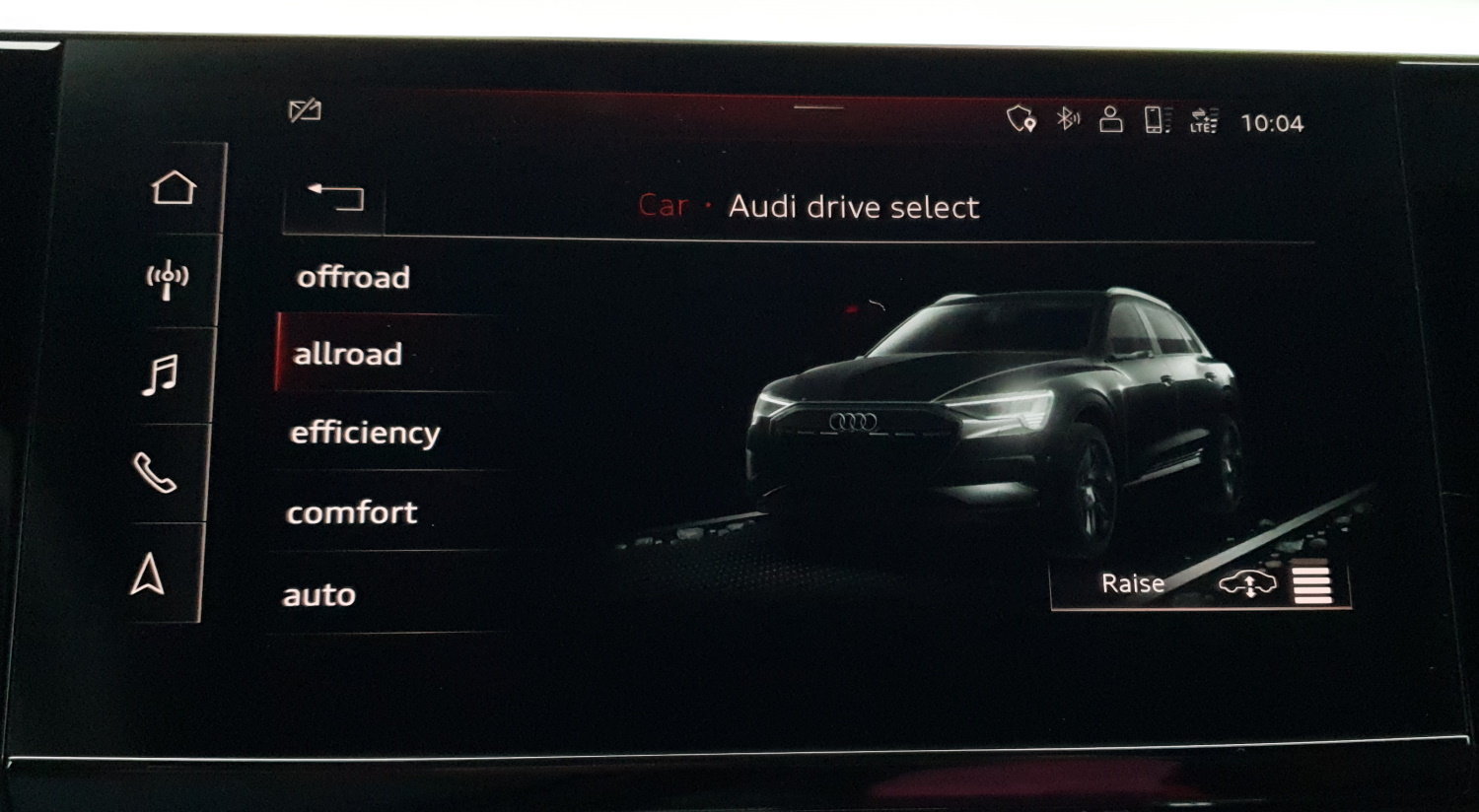
That is not always the same as changing maximum output. Some Eco or Chill calibrations limit acceleration; others mainly make the pedal less sensitive. Some performance modes unlock a higher output or a timed boost, while others make the available output easier to reach. Audi, for example, states that selecting Dynamic in the original e-tron activates its S range and boost function. The same drive-select system also coordinates the steering, air suspension, climate control, and cruise-control calibration. Audi e-tron drive select, quattro, and suspension technical overview
In a multi-motor EV, the mode may also influence which motor is active and how torque is divided between the axles or individual wheels. An efficiency strategy can favor the most efficient motor and connect the second motor only when acceleration or traction requires it. A performance or slippery-road calibration may keep both axles ready to respond, accepting higher losses in exchange for response or stability.
Lift-off regeneration and brake feel
A mode can change the deceleration requested when the driver lifts off the accelerator, but there is no universal relationship between Eco, Sport, and regenerative braking. Strong lift-off regeneration is not automatically an Eco feature, and weak regeneration is not automatically a Sport feature.
The Audi Q4 e-tron illustrates the overlap between separate controls. In D it normally prioritizes coasting, while Dynamic adds some lift-off regeneration; B and the steering-wheel paddles provide other regeneration choices. Audi Q4 e-tron motor, all-wheel-drive, and recuperation overview The Kia EV6 manual gives Snow mode a narrower regeneration range of levels 0–1, while Eco, Normal, and Sport allow levels 0–3. Kia EV6 owner's manual: regeneration levels and drive modes
These examples show why the mode name is not enough. A slippery-road mode may reduce lift-off deceleration to avoid an abrupt torque change at the driven wheels. A performance mode may use strong regeneration to manage speed and brake temperature. Other cars leave regeneration entirely under a separate control.
Regeneration strength and energy efficiency are also different questions. If the car needs to slow, recovering part of its kinetic energy is better than turning all of it into heat in the friction brakes. If it does not need to slow, coasting can avoid an unnecessary energy-conversion cycle. Brake-pedal calibration may blend motor regeneration and friction braking regardless of the selected lift-off behavior.
Steering, damping, and ride height
A drive mode can vary electric power-steering assistance, on-center response, and filtering. It can change the steering ratio only when the vehicle has suitable variable-ratio or rear-steering hardware. More steering weight is a feel choice, not proof of more grip or faster response.
Adaptive dampers can move between comfort-oriented and body-control-oriented calibrations. Air or active suspension may also lower the body at speed to reduce aerodynamic drag, raise it for clearance, or hold a particular height in a performance mode. The original Audi e-tron is a useful hardware-dependent example: Dynamic and Efficiency lower the body, while Allroad and Offroad raise it. A car without adjustable ride height cannot gain ground clearance from a touchscreen selection. Audi e-tron drive select, quattro, and suspension technical overview
Traction, stability, and torque distribution
Snow, Slippery, Off-road, Sand, and performance modes can alter accelerator response, allowable wheel slip, stability-control intervention, wheel-selective braking, and front-to-rear torque allocation. A multi-motor EV can change wheel torque much faster than a combustion vehicle waiting for an engine and multi-speed transmission to respond, but the tyre-road contact still sets the physical limit.
Snow mode does not create grip and does not simply “turn on” ABS or stability control; those are normally core safety systems. The mode can recalibrate how early and how strongly the traction and stability systems intervene. On loose off-road surfaces, a vehicle may deliberately permit more wheel slip so the tyres can clear material or maintain momentum. A physical differential lock is relevant only when that hardware is actually fitted; many EVs instead use motor control, brake intervention, or an electronic differential function.
Off-road modes may also activate hill-descent control, raise an adjustable suspension, change camera views, or modify one-pedal operation. The exact surface, speed, and hardware restrictions in the manual matter because a calibration intended for loose ground may be unsuitable for dry pavement.
Thermal management, climate, aero, and assistance systems
Efficiency modes can reduce climate-system demand, soften cruise-control acceleration, limit speed, lower an adjustable suspension, or favor a low-loss motor strategy. Porsche’s optional Intelligent Range Manager can switch the Taycan to Range mode and adjust the speed limit and climate mode as part of a route calculation. Porsche Taycan Intelligent Range Manager and Range mode
Performance modes can do the opposite: condition the battery for output, increase cooling of the battery and motors, keep more motors active, and accept higher energy use for repeatable performance. Tesla’s Model S Track Mode changes stability control, traction control, regeneration, cooling, adaptive damping, ride height, and handling balance; it also makes driver-assistance features unavailable. Tesla Model S owner's manual: Track Mode
Some modes additionally change synthesized sound, displays, seat bolsters, ambient lighting, or camera layouts. Those cues can help the driver recognize the active state, but they should not be confused with a mechanical change.
What the common mode families usually mean
Manufacturers use different names and bundle different systems, but most modes fall into a few broad families:
- Normal, Comfort, or All-purpose: the default compromise for predictable response, comfort, energy use, and full safety-system support. Comfort may soften adaptive damping and accelerator response, but it does not necessarily reduce maximum power.
- Eco, Efficiency, Conserve, or Range: reduces unnecessary energy demand through gentler response, climate or speed limits, aerodynamic ride height, selective motor use, or route-aware control. It may or may not change regeneration.
- Sport, Dynamic, Performance, or GT: sharpens response and may change steering effort, damping, ride height, torque distribution, cooling, regeneration, stability thresholds, and available boost. The label does not prove that maximum power increases.
- Snow, Ice, Slippery, or Wet: prioritizes controllable torque delivery and stability on a low-friction surface. It commonly softens accelerator response and can limit lift-off regeneration, but suitable tyres and cautious inputs remain decisive.
- Off-road, All-terrain, Sand, Mud, Rock, or Crawl: calibrates the car for a defined loose or uneven surface. Depending on the hardware, it can raise ride height, change wheel-slip targets, engage an electronic differential function, alter regeneration, or activate hill-descent control.
- Tow/Haul or Trailer: coordinates propulsion, deceleration, stability control, range prediction, and sometimes suspension behavior for a load. It does not increase the certified towing limit.
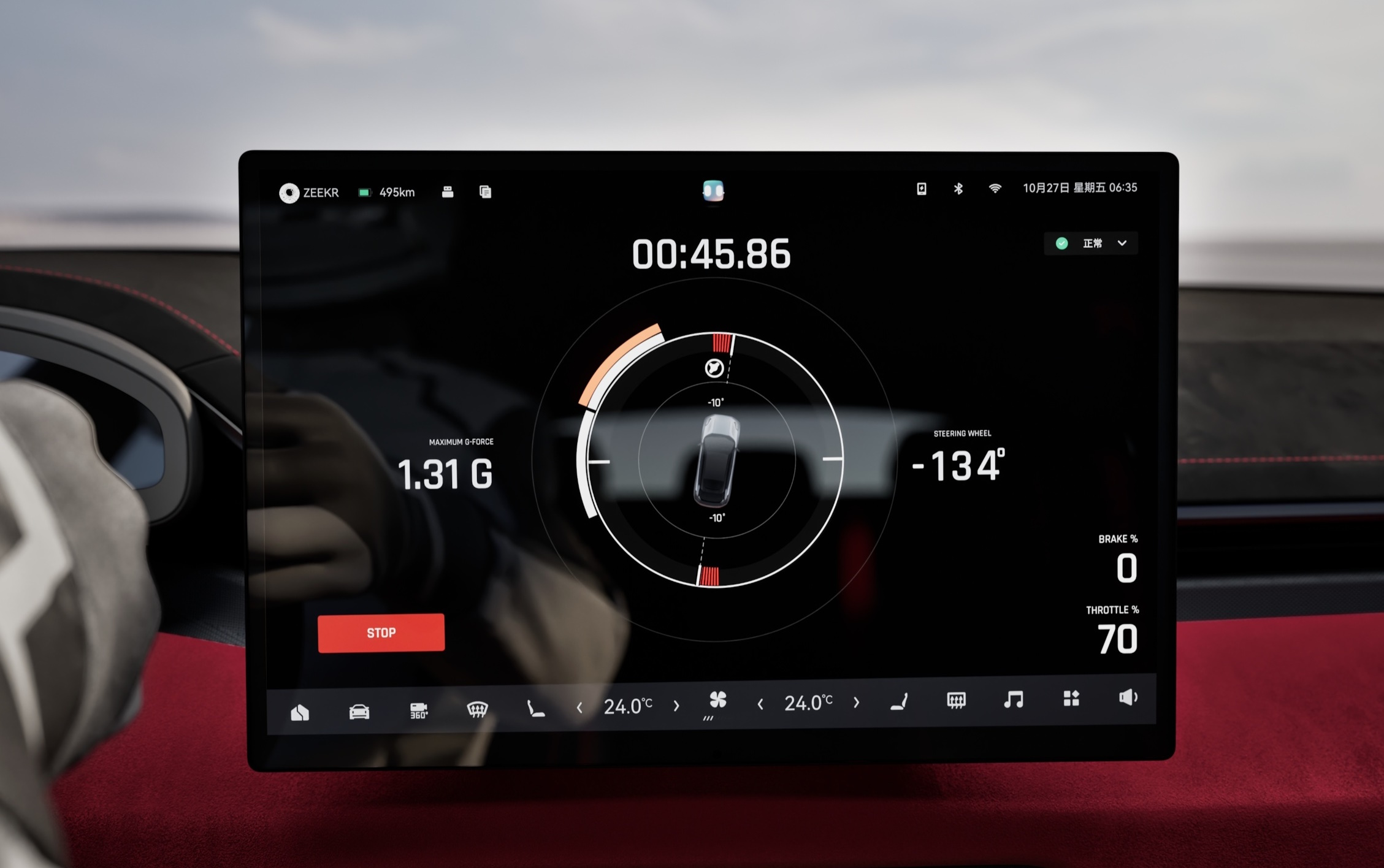
- Track, Circuit, Drift, or Drag: prepares a performance EV for a narrow task and can reduce stability intervention, change torque balance, increase cooling, or condition the battery. These modes can raise energy use and component temperatures and may disable assistance systems. Track-only modes belong on a closed course.
- Auto or Adaptive: lets the car choose or blend calibrations using driving style, road conditions, navigation, and sensor inputs. The driver still remains responsible for selecting a mode that the manual requires for a special surface or load.
- Individual, Custom, or My mode: lets the driver combine supported settings rather than accepting one fixed package. Not every combination is available, and safety-related settings may reset after the car is restarted.
Dedicated modes can go much further than changing pedal response. A track calibration may expose separate controls for front-to-rear handling balance, stability assistance, regeneration, and thermal endurance.
Do Eco and Range modes extend range?
They can help, but they do not add battery energy. Their benefit comes from changing the car’s behavior or making efficient driving easier.
The most useful mechanisms are a smoother torque request, reduced peak acceleration, a lower speed ceiling, less aggressive cruise-control response, restrained cabin heating or cooling, lower aerodynamic ride height, and efficient use of multiple motors. A range mode can also coordinate navigation and charging so the car reaches a destination with fewer or better-timed stops.
Driver behavior and conditions still dominate many journeys. The U.S. Department of Energy notes that rapid acceleration reduces EV range, while high-speed travel, extreme temperatures, heavy loads, and climbing also raise energy demand. U.S. Department of Energy: EV efficiency and driving range An Eco map can make gradual acceleration easier, but a driver can reproduce much of that benefit with a steady right foot in Normal mode. Conversely, repeatedly requesting strong acceleration in Eco can erase the benefit.
More lift-off regeneration is not a guarantee of lower consumption. Use regeneration when speed must be reduced; preserve momentum when it is safe and appropriate to coast. The vehicle’s automatic regeneration and blended-braking logic may handle that choice more efficiently than a fixed high lift-off setting.
A range estimate may change as soon as a mode is selected because the prediction assumes different future speed, climate, or power use. Treat the number as a forecast, not energy newly added to the battery. For a meaningful comparison, measure consumption over the same route, speed, weather, cabin setting, tyre pressure, and traffic conditions.
Safety and practical limits
A drive mode cannot compensate for unsuitable tyres, excessive speed, insufficient ground clearance, an overloaded vehicle, or poor judgment. It can only use the available hardware within its calibrated limits.
On snow and ice, gentle accelerator, steering, and brake inputs remain essential. Do not assume that stronger lift-off regeneration is safer; the vehicle may deliberately limit it in a slippery mode. Use tyres appropriate for the conditions and leave more stopping distance.
Before using an off-road, tow, or performance mode, check the manual for surface restrictions, speed limits, ride-height behavior, one-pedal availability, stability-control changes, and any required equipment. Confirm the active indicator after startup because some special modes reset or require a stationary vehicle before selection.
Track and drift modes deserve particular caution. Tesla explicitly limits its Track Mode to closed circuits, warns that stability behavior changes, and disables driver-assistance functions while the mode is active. It also reports increased energy use and uses more aggressive thermal management. Tesla Model S owner's manual: Track Mode Similar labels on another EV do not guarantee the same safeguards or behavior.
What buyers and owners should check
The mode list in a brochure is less useful than knowing what each selection controls. For the exact vehicle, check:
- whether accelerator response, maximum output, or both change;
- whether a second motor, boost function, or battery conditioning is activated;
- how lift-off regeneration, one-pedal driving, and brake-pedal feel behave;
- whether steering assistance, steering ratio, damping, roll control, or ride height changes;
- how traction control, stability control, torque distribution, and driver assistance are affected;
- whether climate performance, top speed, active aero, or cruise-control response is limited;
- whether the mode persists after restart or is tied to a driver profile;
- which surfaces, speeds, loads, tyres, or other equipment the mode requires.
The best everyday mode is usually the one that gives predictable response without making the driver fight the calibration. Use the specialized modes for the conditions and tasks their manufacturer defines, and judge them by their documented system changes rather than by the name or dashboard graphics.
Sources
- Audi e-tron drive select, quattro, and suspension technical overview
- Audi Q4 e-tron motor, all-wheel-drive, and recuperation overview
- Kia EV6 owner's manual: regeneration levels and drive modes
- Porsche Taycan Intelligent Range Manager and Range mode
- Tesla Model S owner's manual: Track Mode
- U.S. Department of Energy: EV efficiency and driving range