
Hitch-mounted cargo carriers
A hitch-mounted carrier keeps cargo out of the cabin and usually below the roofline, but its safe capacity is governed by leverage as well as mass. Vehicle, hitch, carrier, rear-axle, tire and local-equipment limits must all be checked.
Common carrier designs
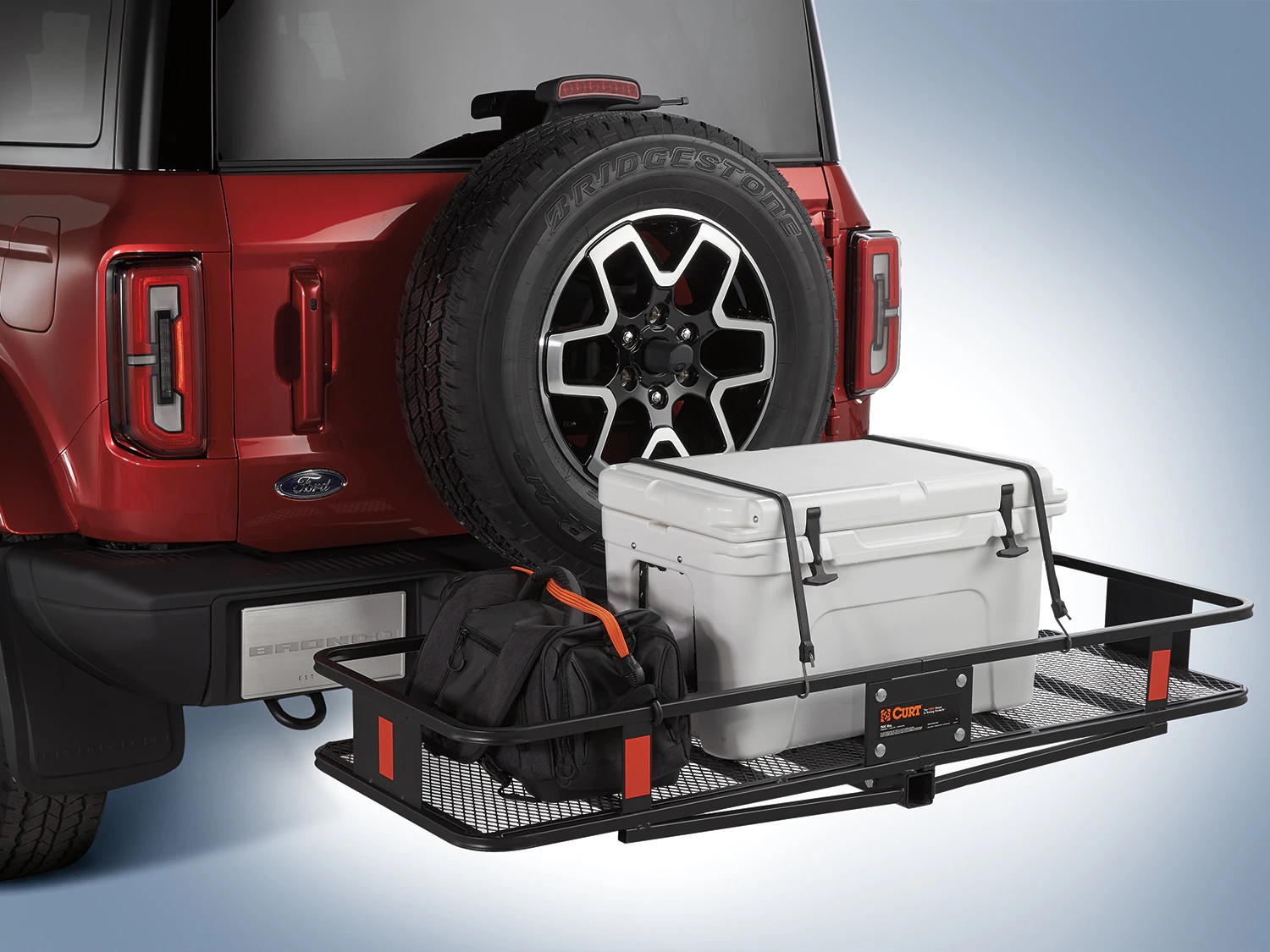
Basket
An open basket accepts boxes, bags and coolers when they are restrained on every axis. A weatherproof bag or cover can protect the contents, but the cover does not replace structural tie-downs.
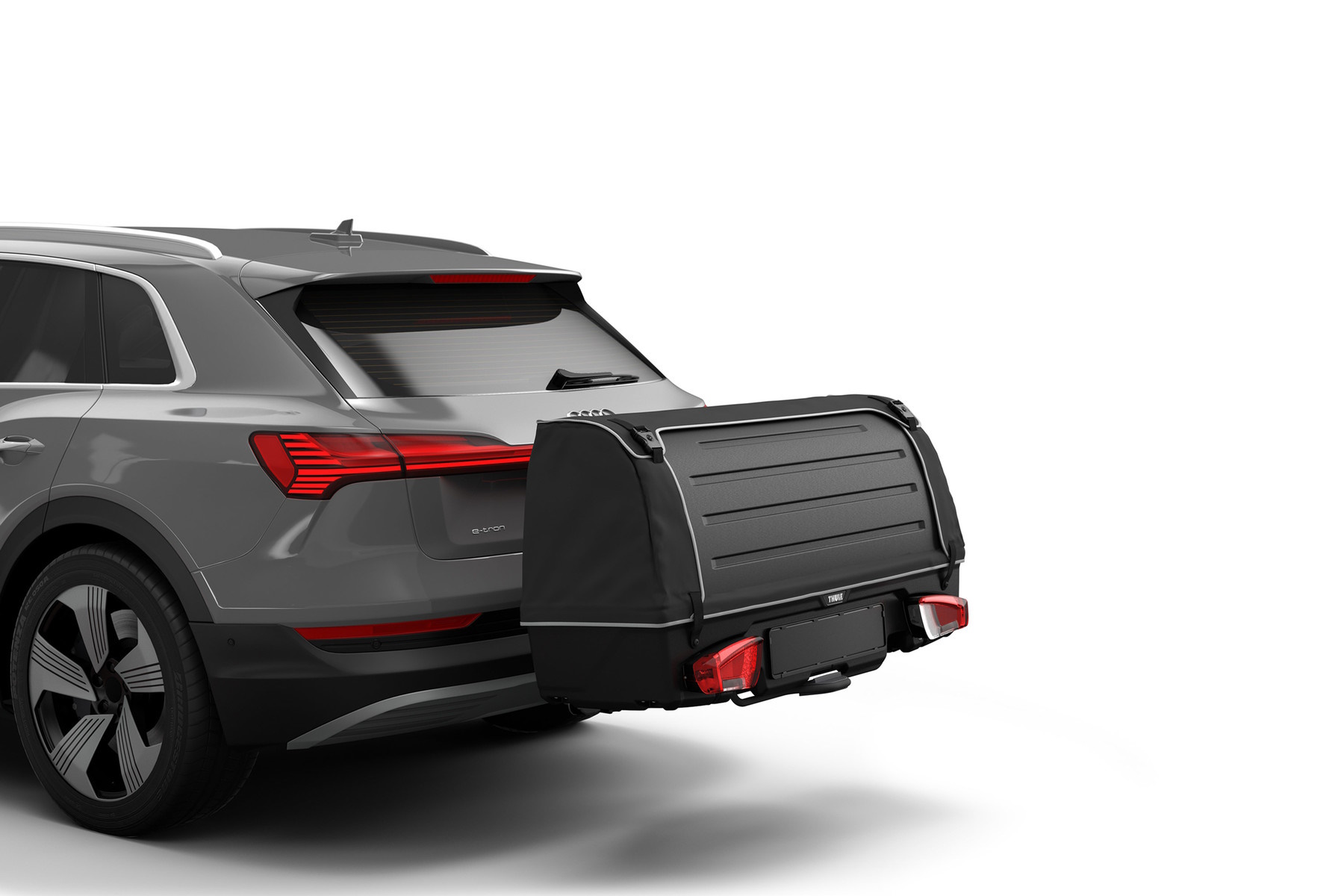
Box
An enclosed box protects cargo from spray and casual access. Its own mass, maximum load and center-of-gravity position must be included in the calculation.
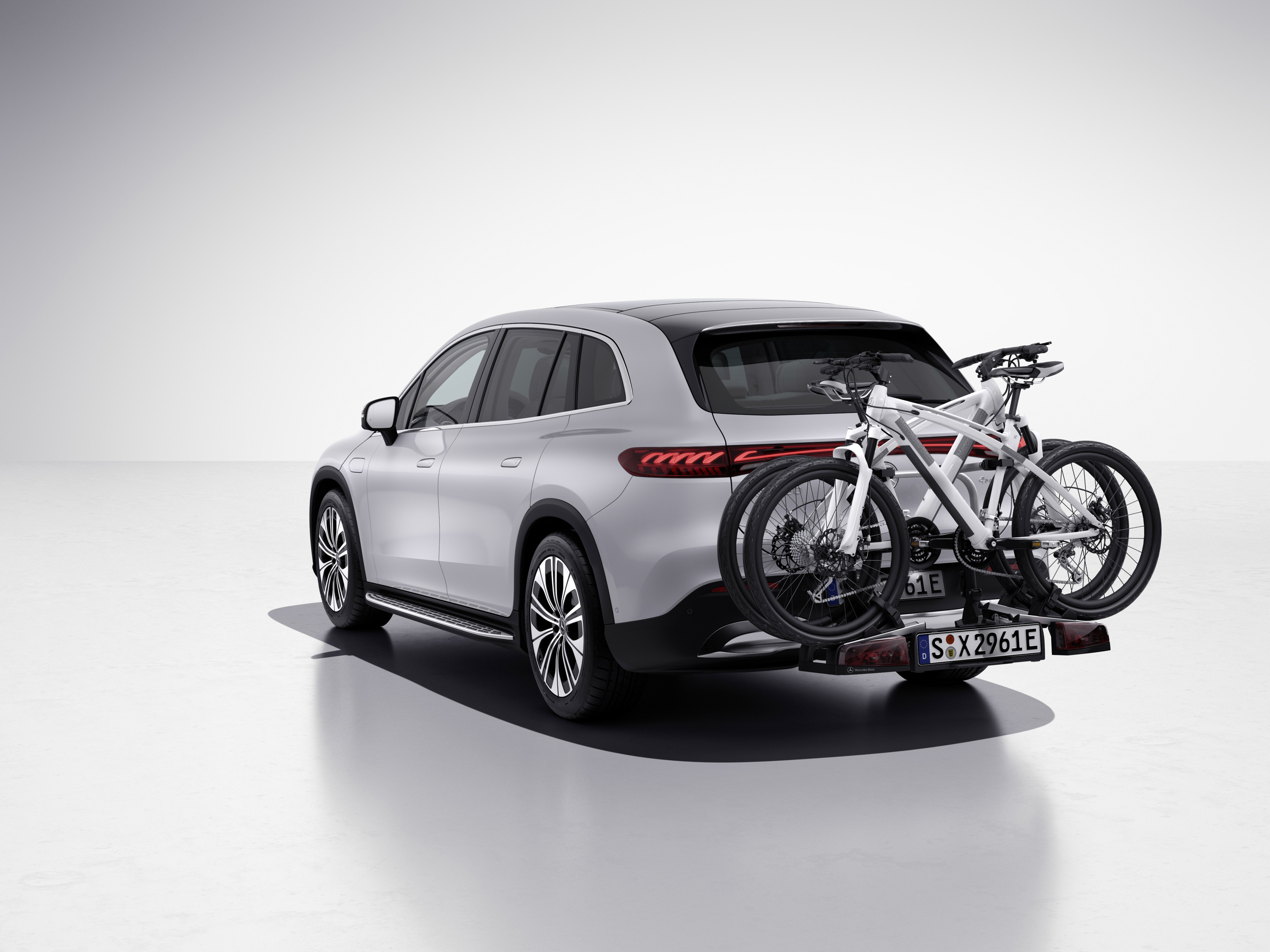
Equipment rack
A purpose-built rack carries bicycles, skis or other defined equipment at approved contact points. Adapters, extensions and swing-away mechanisms move the load farther rearward and can reduce the permitted mass.

Why carrier load differs from tongue weight
A trailer applies vertical load close to the coupling point. A cargo carrier holds its mass behind that point, creating a bending moment. In simple terms, the moment grows when either the mass or its horizontal distance from the hitch increases.
This is why a vehicle's maximum trailer tongue weight must not be reused as a carrier rating. Current European Tesla manuals provide a clear example: Model Y lists up to 72 kg for a recommended accessory carrier, while Model X lists 54 kg when the carrier load is cantilevered within 63 cm of the coupling. The carrier itself is included in both figures. These are vehicle-specific examples, not general limits.
Check all of the following:
- the vehicle's accessory-carrier rating and permitted center-of-gravity envelope;
- the hitch or coupling rating;
- the carrier, adapter and extension ratings;
- remaining vehicle payload and rear-axle capacity;
- rear-tire load and pressure requirements.
Rear access and vehicle systems
A carrier can obstruct the tailgate, rear window, registration plate, lamps, exhaust outlets on a range-extender or hybrid, cameras, radar or ultrasonic sensors. Some driver-assistance and automatic-braking functions may become unavailable or behave differently.
Use the required lighting board or wiring connection when the carrier or load obscures the vehicle's lights or plate. Requirements vary by jurisdiction.
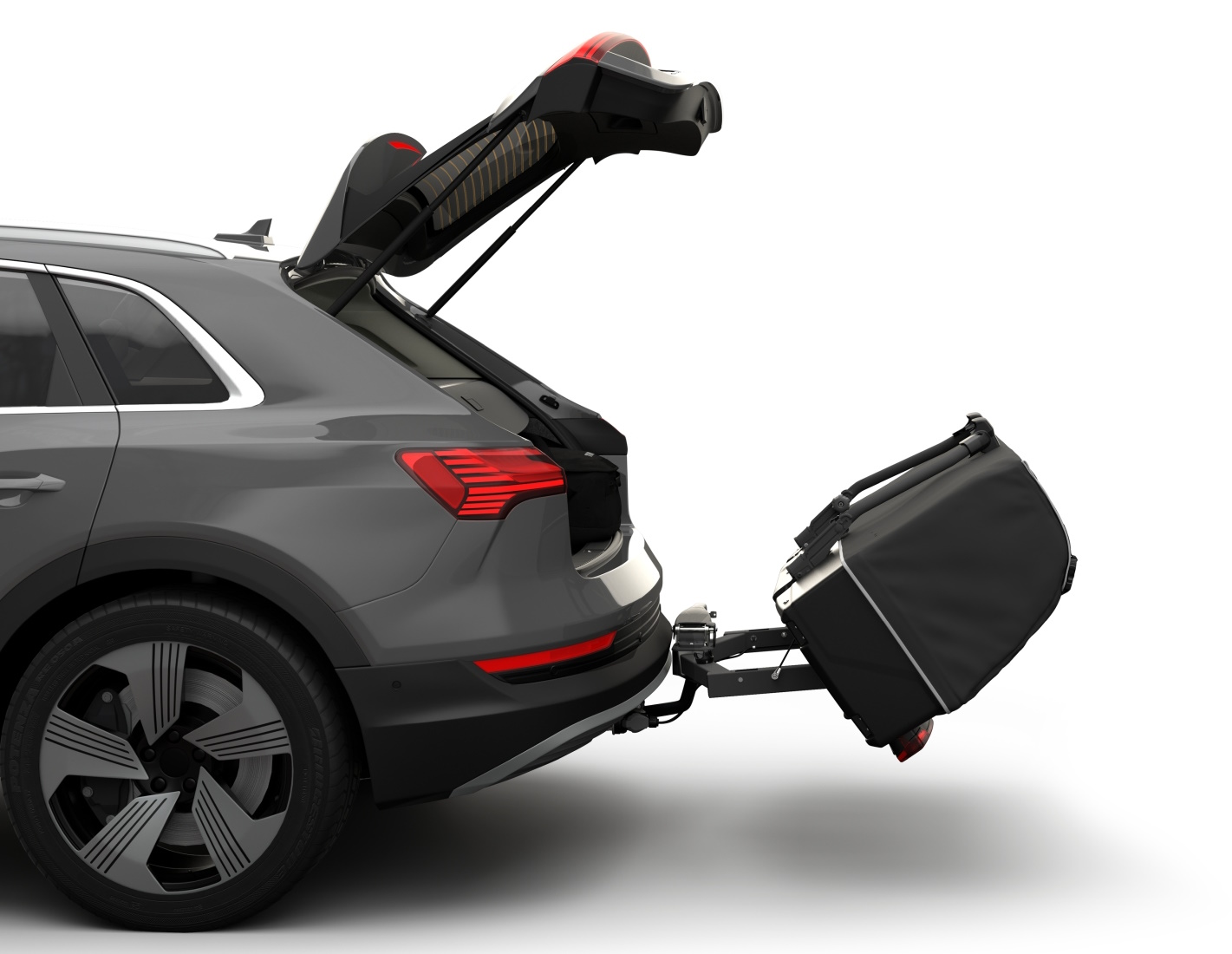
Folding and swing-away mechanisms improve access only when used according to their instructions. Confirm that the mechanism is locked in its travel position before driving.
Aerodynamics and energy use
A rear carrier often places cargo in a lower-speed wake behind the vehicle, which can produce less drag than carrying the same item on the roof. It does not make the load aerodynamically invisible. Width, height, gaps, distance behind the body and interaction with the wake determine the result.
The embedded comparison below is useful as one real-world configuration. It should not be converted into a percentage for other vehicles, speeds, boxes or weather conditions.
Added mass still affects acceleration, climbing and rolling resistance. Monitor actual consumption early in the trip rather than relying on the unloaded range estimate.
Loading and inspection
Place dense items as close to the vehicle and as low as the carrier permits. Restrain the load against movement in every direction, keep it within the carrier's outline and protect it from wheel spray and road heat.
Before departure and at each charging stop:
- Confirm the hitch, locking pin, anti-rattle device and carrier fasteners are secure.
- Check that the load and straps have not shifted.
- Test any added lights and confirm that the plate remains visible.
- Verify tailgate clearance before opening it.
- Inspect tire pressure and rear ride height.